

Nuclear Tomorrow - October 2025
Nuclear Tomorrow is a newsletter that is issued monthly to identify press reports on developments in the field of nuclear energy. Topics are selected for their relevance to the impact of nuclear energy on global warming. The newsletter is written for members of the general public who are concerned with policy related to these issues. Postings are categorized as dealing with Technology (T), Policy (P), and/or Construction (C). In some cases registration or a fee is required to access an article. Hyperlinks are provided to connect newsletter posts to the referenced publication. (See hot buttons associated with each posting) The newsletter is intended to expand on topics included in the book, “Nuclear Energy: Boom, Bust, and Emerging Renaissance,” which has recently been published by Oxford University Press. The author of the book and of this newsletter is Edward A. Friedman, Emeritus Professor of Technology Management at Stevens Institute of Technology in Hoboken, New Jersey, USA. The book is available for purchase via the Oxford University Press Website. The following link provides access to the book:
https://global.oup.com/academic/product/nuclear-energy-9780198925781?lang=en&cc=gb#
NOTE - A 30% Discount is available using the code AUFLY30
for purchases through Oxford University Press
The release date for the print editions was October 3, 2025
1.
Urenco USA given go-ahead for 10% enrichment (T)
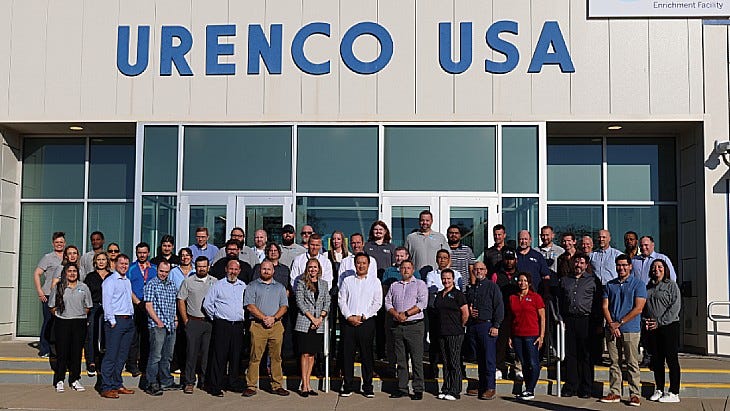
Urenco USA has received authorization from the US Nuclear Regulatory Commission to produce Low Enriched Uranium Plus (LEU+) nuclear fuel. This is uranium that is enriched to between 5% and 10% levels of Uranium 235. This level of enrichment supports more efficient operations and longer operating cycles. It will also be able to fuel more advanced designs that are under development. Urneco’s facility in Eunice, New Mexico is the only operational commercial enrichment plant in the United States today.
2.
Russia Leads US Nuclear Fuel Imports in 2024, Defying Enriched Uranium Ban (T)
While the U.S. had a formal ban imposed in May of 2024 on imports of enriched uranium from Russia, exceptions were granted that allowed it to maintain its position as the leading supplier of nuclear reactor fuel. However, the level of 20% was a decline from the 27% percentage from 2023.
3.
Four companies picked for fast-tracked fuel fabrication ( C )
The Department of Energy has fast-tracked four additional selections for the Fuel Line Pilot Program. The four companies are Oklo, Terrestrial Energy, TRISO-X, and Valor Atomics. Standard Nuclear was identified for this program earlier. This authorization is through the Department of Energy rather than the Nuclear Regulatory Commission to allow more rapid deployment of new fuels that would supply the DOE’s accelerated Reactor Pilot Program for which 11 designs have been selected. Each of these four companies have at least one reactor in the Reactor Pilot Program - as follows:
Oklo - a sodium cooled fast reactor
Terrestrial - a molten fluoride salt cooled reactor
TRISO-X a high temperature gas cooled reactor
Valor Atomics - a high temperature gas cooled reactor
While Standard Nuclear is focussed on TRISO fuel development intended for several designs including a high temperature gas cooled reactor.
4.
US plans to power AI data centers with advanced nuclear energy at historic sites (P)
The US National Nuclear Security Administration (NNSA) has issued requests for proposals to construct and operate major Artificial Intelligence data centers, signaling a strong push to pair next-generation computing with advanced nuclear energy. These proposals are to utilize historic nuclear sites at Savannah River and Oak Ridge.
5.
Slovak leader announces a deal with US on a new nuclear reactor ( C )
Slovakia’s prime minister announced on October 7th that his government has approved an agreement with the US to build a 1,200 megawatt nuclear reactor. A date was not announced for signing the deal. It is expected that this reactor will be constructed by Westinghouse.
6.
France’s Energy Giant Sees Opportunity in the Volatile Electricity Market (P)
The large French company TotalEnergies is investing in a battery farm at the site of a shutdown refinery at Dunkirk. The farm consists of more than two dozen industrial-scale batteries. They are connected to the power grid and kick in with almost instantaneous electricity when required by consumption needs such as from a nearby aluminum plant or unavailability of renewables. TotalEnergies is investing up to $4 billion a year in electric power to meet expanding requirements of electric vehicles and data centers along with general growth of electricity usage and the closing of fossil fuel-based plants.
7.
First molten-salt reactor in the desert - China’s 2030 bet on safer nuclear power ( C )
Construction will start in 2025 of a 60 Megawatt thermal thorium cooled reactor, based on a 2 Megawatt prototype that entered criticality in 2023, at the same location in the Gobi desert. Thorium salts provide an effective coolant in this location that is devoid of water as a potential coolant. The goal of this project is to have this reactor online by 2030. While thorium based fission was shown to be feasible in the United States in 1969, the program at Oak Ridge was abandoned. In this reactor, thorium absorbs a neutron to transform into Uranium 233 which undergoes heat producing fission. This fission reaction does not create plutonium with its associated long lived isotopes. Furthermore, China is estimated to have 280,000 tons of thorium reserves ( second only to India’s 340,000 tons ), enough fuel to supply energy to the country’s vast population for an estimated 20,000 years.
8.
Washington (state) nuclear facility will deploy 12 Amazon-funded SMRs ( C )
Amazon is funding the construction of an energy facility outside of Richmond, Washington with a planned capacity of 960 Megawatts of electrical energy. The facility which will be built starting in 2030 will have a 320 Megawatt unit in its first phase. The 320 Megawatt facility will consist of three Xe-100 small modular reactors built by X-Energy in collaboration with Korea Hydro & Nuclear Power and Doosan Enerbility. The Xe-100 is a high temperature gas cooled reactor. This is the first phase of an ambitious 5 gigawatt initiative that is planned for implementation by 2039.
9.
Army Launches Project Janus to Deploy Nuclear Microreactors on Military Installations ( C )
In an initiative to provide electric power to domestic military installations, that is independent of the civilian power grid, the Army is launching Project Janus which will deploy commercially owned and operated microreactors. This initiative will build on lessons learned from Project Pele, a Generation IV nuclear power project being implemented by the military. The microreactors will be designed to be transportable and capable of operating for extended periods of time without refueling. An objective of the program is to provide energy for military installations that provides continuity of power in the event of grid outages and vulnerabilities arising from fuel availability. First prototype criticality is scheduled for July 4, 2026 and operational capability for September 30, 2028. Project Janus anticipates installation of 12 microreactors across 9 military installations. The Project Pele reactor is designed to produce 1.5 Megawatt of electrical power and to be operational for three years without refueling. It is designed to be transportable in four 20 foot shipping containers, making it transportable by truck, rail, ship or aircraft.
10.
Perovskite: The ‘wonder material’ that could transform solar (T)
The term perovskite refers not to a specific material like silicon but to a whole family of compounds named for a mineral called perovskite. There are many variations of this material that are possible. There has been an ongoing search for a form that could replace or supplement silicon in the fabrication of solar panels. The material has a higher energy conversion rate than silicon with the advantage that solar cells manufactured from perovskite can operate with more defects than silicon solar cells. Silicon only cells have an energy conversion efficiency of typically 21-23% with a theoretical maximum of 33%, while a silicon cell enhanced with perovskite has a maximum of 47%. However, they are less durable than silicon solar cells which has prompted a search for perovskite material with lifetimes comparable with that of silicon solar cells. Companies pursuing perovskite energy technology have emerged from Oxford University, MIT and elsewhere. Factories have been established to manufacture pilot models. Their use with electric vehicles is an application that holds great promise provided the durability issue can be resolved.
11.
Palisades Nuclear Plant receives new fuel in historic restart effort ( C )
The Palisades Nuclear Generating Station is a Pressurized Water Reactor designed to produce 725 kilowatts of electric power that became operational 1973 and was decommissioned in 2022. It is located on the banks of Lake Michigan. Through an initiative supported by Governor Gretchen Whitmer it was approved to reopen in 2025, making it the first reactor in the United States to be reopened.
A detailed description of the fuel assemblies for this reactor were provided by the manufacturer, Holtec. There are 204 fuel assemblies in the reactor when in operation. Each fuel assembly - measuring 12 feet in length - contains 216 fuel rods. Approximately 200 fuel pellets of uranium oxide are stacked into each fuel rods. Each fuel pellet - which is about the size of a
pencil eraser - contains roughly the same energy potential as a ton of coal.
A date for this restart has not yet been announced.
12.
Urenco doubles expansion plans for uranium enrichment in the Netherlands (P)
Uranco has announced plans to double the capacity of its uranium enrichment plant in the Netherlands. This adds to its expanded capacity in Eunice, New Mexico and enhancement of its capacity in Gronau, Germany. It also operates a plant in Capenhurst in the UK.
13.
Restart of Huge Nuclear Power Plant Faces Backlash in Japan (P)
Tokyo Electric Power Company (TEPCO) is facing resistance to its plans to reopen the Kashiwazaki-Kariwa power plant that was closed following the Fukushima accident in 2011. At that time all of Japan’s reactors were closed. In recent years, 14 reactors have restarted and the restart of 11 others is being pursued. Restart of the Kashiwazaki-Kariwa plant is stalled by the lack of approval to date from local and regional authorities. The reactor complex at this site consists of 7 reactors with a capacity of just under 8 Megawatts of electrical energy.
14.
Bill Gates-backed 345 MWe advanced nuclear reactor secures crucial US approval ( C )
The Terrapower Natrium reactor that is under construction in Wyoming has received approval of its Environmental Impact Statement from the NRC. This is the first-ever advanced commercial reactor to do so. It is now eligible to be granted
a full construction permit.
15.
Is nuclear power becoming cool in Colorado? Discussion of role for it is growing (P)
Colorado has a new law declaring nuclear power a source of clean energy. This has unleashed many conversations about the potential use of nuclear energy in the state. While its use for data centers is a likely option, nuclear energy for the airport and other facilities is under discussion. There is strong support for the use of nuclear energy by the state’s leadership, but it faces an organized opposition. The state is now engaging in active discussions and debate.
16.
Westinghouse signs $80B contract to meet AI demand ( C )
The U.S. government has signed an $80 billion deal with Westinghouse Electric Company to build large-scale nuclear reactors to support growing electricity demand from artificial intelligence. This initiative includes two additional partners -Brookfield Asset Management and Canadian uranium producer Cameco Corporation. Westinghouse is currently owned by Canadian entities including Brookfield and Cameco. The funding will support construction of AP1000 reactors that Westinghouse developed. Two such reactors were built in Georgia in what can only be described as a sub-optimal program. However, both China and South Korea have been successful in building reactors based on the AP1000 design with China doing so in-country and South Korea in the United Arab Emirates. Westinghouse went into bankruptcy in pursuing the Georgia project. This contract provides a fresh start for this historically U..
17.
Rethinking Nuclear - An overview of “Nuclear Energy: Boom, Bust, and Emerging Renaissance.” (P)
The Oxford University Press featured the book authored by the publisher of this Substack - Edward A. Friedman - on their Blog