

Nuclear Tomorrow - November 2025
Nuclear Tomorrow - November 2025
Nuclear Tomorrow is a newsletter that is issued monthly to identify press reports on developments in the field of nuclear energy. Topics are selected for their relevance to the impact of nuclear energy on global warming. The newsletter is written for members of the general public who are concerned with policy related to these issues. Postings are categorized as dealing with Technology (T), Policy (P), and/or Construction (C). In some cases registration or a fee is required to access an article. Hyperlinks are provided to connect newsletter posts to the referenced publication. (See hot buttons associated with each posting) The newsletter is intended to expand on topics included in the book, “Nuclear Energy: Boom, Bust, and Emerging Renaissance,” which has recently been published by Oxford University Press. The author of the book and of this newsletter is Edward A. Friedman, Emeritus Professor of Technology Management at Stevens Institute of Technology in Hoboken, New Jersey, USA. The book is available for purchase via the Oxford University Press Website. The following link provides access to the book:
https://global.oup.com/academic/product/nuclear-energy-9780198925781?lang=en&cc=gb#
NOTE - A 30% Discount is available using the code AUFLY30
for purchases through Oxford University Press
1.
More support for tripling global nuclear capacity (P)
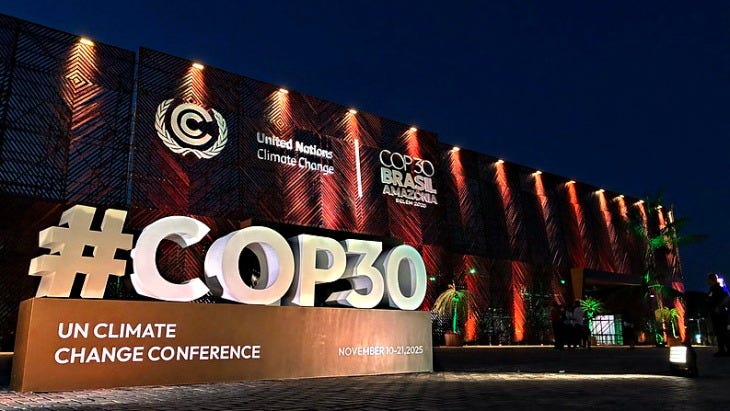
At the COP30 climate conference in Belem, Brazil both Rwanda and Senegal announced plans to develop nuclear energy. In doing so they join the 31previous countries that have committed to at least tripling global nuclear energy generation by 2050. They are joining Ghana, Kenya and Nigeria who are the other sub saharan African countries included in the group of 31.
2.
China is Racing to Lead the World in Nuclear Power (P)
China seeks to dominate the world market for nuclear technology. Currently, Russia is the largest exporter of nuclear reactors and the United States has the largest inventory of nuclear reactors, but China is moving vigorously in development of nuclear technology and by 2030 may overtake both countries. Since 2013 China has built 13 reactors and has 33 under construction.
3.
Britain Gives Go-Ahead to Smaller Nuclear Reactor in Wales ( C )
Rolls Royce SMR has announced that they will construct a small modular nuclear reactor on Anglesey island, Wales. This will be the first such reactor in the UK. They plan to fabricate components in factories and then transport the modular units to the operational sites.
4.
Sweden bets on nuclear power to drive economic growth and cut emissions (P)
The Swedish government plans to build between three and five small modular reactors at the Ringhals plant in southwestern Sweden. They are expected to supply around 1,500 megawatts of power.
5.
First American Nuclear and the State of Indiana Introduce the First “Closed-Fuel Cycle” Nuclear Energy Park in the U.S. -- Reprocessing and Reusing Fuel Onsite ( C )
First American Nuclear (FANCO) plans to build a fast spectrum SMR in the state of Indiana. The planned reactor is designed to reprocess and reuse spent fuel on-site, eliminating 97% of long lasting waste. The EAGLE-1 reactor can create more fuel than it burns. It plans to use lead bismuth as a coolant and is designed to generate 240 Megawatts of electricity. Due to the benign properties of lead bismuth the design does not require complex safety systems.
6.
EDF aims to produce 30 small modular reactors by 2050, design by 2026 ( C )
France’s state owned nuclear power producer EDF plans a major small modular reactor initiative with a goal of having 30 reactors in service by 2050. The power output is expected to be 400 Megawatts of electrical energy. The conceptual design is expected to be completed in 2026. These SMRs will be marketed globally.
7.
U.S. states take steps towards nuclear new build (P)
Legislators in Illinois lifted the state’s moratorium on construction of new large reactors. During the same week the New York state Power Authority issued solicitations for development of advanced nuclear reactors in upstate communities. This follows a call earlier in the year by New York’s governor for the Authority to do so. Governor Pritzker in Illinois is supporting the legislature’s initiative as part of a clean energy program.
8.
Westinghouse and Hungary Establish Landmark Nuclear Fuel Partnership ( C )
Westinghouse has signed a contract to provide fuel for a Russian designed and constructed reactor in Hungary VVER-440. This follows developments in which Westinghouse has partnered with Finland, Ukraine, the Czech Republic and Bulgaria to also resupply fuel for Russian built VVER reactors. This fuel will be manufactured in Europe. With this agreement Westinghouse has now taken over all VVER refueling in Europe for reactors that were installed by Russia
9.
For 1st time ever, Utah would take radioactive waste from another country under EnergySolutions proposal (P)
A Utah company plans to import Canadian radioactive waste. This plan is subject to review and approval by several agencies and the state of Utah. This is the lowest level of radioactive material, designated Class A. It consists of contaminated protective clothing, filters, cleaning rags, medical swabs, and syringes. Components of decommissioned nuclear power plants could also be included. In 2008 a plan to store waste from a dismantled nuclear plant in Italy was vetoed by the Governor,
10.
ANS Winter Conference: Nuclear start-ups applaud DOE executive order on reactor testing (P)
Leaders of advanced reactor companies participating in the Department of Energy’s Reactor Pilot Program to get at least three new reactor designs on line by July 4, 2026 spoke at the ANS Winter Conference. They were from Radiant Industries, Oklo, and Valar Atomics. They praised the program to fast-track reactor development.
11.
Czech Republic plans $19 billion nuclear expansion to end fossil fuel reliance ( C )
The Czech Republic has finalized a contract with South Korea’s KHNP for construction of two 1,000 Megawatt electric reactors that will add to their existing nuclear capability of over 2,000 Megawatts electric. The target date for these reactors is the second half of the 2030s. The country plans to generate around 60% of its electrical energy by 2050 with nuclear.
This initiative is part of an increase of incorporation of nuclear energy in national plans throughout Europe with programs in Belgium, Sweden and Poland along with Denmark and Italy. Plans to phase out nuclear energy in multiple countries have been reconsidered. However, Austria remains nuclear skeptical.
12.
Cost-conscious utilities resist Trump’s push for nuclear revival (P)
While small modular reactors are in production in the United States, large 1000 Megawatt electric reactors are not receiving a favorable response to Trump’s offer to subsidize their construction. This article reviews the reactions of several utility companies to Trump putting $80 billion on the table. The history of the Westinghouse program that resulted in the Vogtle reactor in Georgia being far over budget and experiencing excessive delays is cited as the cause of this reluctance. Also cited is the cancellation of a similar reactor in South Carolina. The Vogtle reactor program also led to the bankruptcy of the Westinghouse nuclear company. What is not mentioned is that China and South Korea which built their own versions of the Westinghouse reactor have been successful in building their models.
13.
Give Nuclear Power Another Chance (P)
This Opinion piece points out that 9 states, including California, have restrictions on construction of nuclear reactors. The essay calls on these states to acknowledge that it will be difficult to eliminate greenhouse gases without some role for nuclear and should consider changing their laws. It is also noted that nuclear is treated as singularly dangerous while the reality is that pollution from fossil fuels kills large numbers while nuclear waste can be managed safely.
14.
US strikes $80 billion deal for new nuclear power plants ( C )
Through a Trump initiative to promote nuclear energy the US Government is entering into an agreement with the Canadian owners of Westinghouse Electric for a $80 billion investment in construction of 10 large nuclear reactors by 2030. Westinghouse, which entered bankruptcy in 2017 as a result of their struggles to build the Vogtle reactors in Georgia was taken over by Canadian companies Cameco and Brookfield. Under the proposed deal the US Government would be assigned 20% of future profits. Westinghouse has yet to demonstrate that it has the capacity to fulfill this plan.
15.
Chinese molten salt reactor achieves conversion of thorium-uranium fuel (T)
In an experimental 2 Mega Watt reactor in WuWei that is cooled with liquid salts the generation of new fuel through the addition of thorium was achieved. The thorium is converted into Uranium 233 which sustains a chain reaction. The next phase in this project is the construction of a 100 Mega Watt reactor that is scheduled to become operational in 2035. This event marks the first operational refueling of a reactor utilizing thorium. This marks a strategic breakthrough for China which is heavily dependent on Russia for uranium to fuel its reactors. Given that China has abundant Thorium deposits, switching to that as a nuclear fuel would be a significant development.
16.
Restart of two Taiwanese plants feasible, ministry says (P)
Two boiling water reactors that were closed in Taiwan 2018 and 2019 after 40 years of operation are being considered for reopening.
Given a need for clean energy, an assessment has been made that these reactors are eligible for restart and could apply for licenses of an additional 20 years. It is anticipated that that application process will begin in 2026.
Overview of Restarts Globally
This initiative in Taiwan adds to other global initiatives for reactor reopenings:
United States: Palisades Nuclear Plant in Michigan
Three Mile Island Plant in Pennsylvania
Duane Island Energy Center in Iowa (under review)
Japan: 14 reactors out of 54 closed after Fukushima have
been restarted.
4 additional reactors now being considered for
Restart.
Germany 6 reactors have been proposed for restart
Belgium 9 reactors have been approved for restart
Sweden 2 reactors being studied for restart
5 reactors being studied for life extensions
17.
Deep Fission Plans to Sink Nuclear Reactors Deep Underground (T)
Deep Fission, a California-based startup is pursuing multiple initiatives for development of a small modular reactor called Gravity that would fit into a borehole roughly three-quarters of a meter wide that would operate one mile underground. They claim that using geological depth as containment could make nuclear energy cheaper, safer, and deployable in months at a fraction of a conventional plant’s footprint. However this innovative design introduces both regulatory and practical uncertainties.
They plan to use techniques developed by the oil and gas industry to protect the water table. In the event of a disruption such as an earthquake, they plan to seal the system off at the bottom of the borehole thus creating safe waste disposal containment.
Construction is anticipated to take about six months, including four weeks of drilling, 8 to 10 weeks of installation of lowering the canister into the hole, and another two months for commissioning. For waste management Deep Fission plans deep geological disposal in the very borehole systems that deploy the reactor. The company claims that overall costs would be cut by 70 to 80 percent. Unknowns include stability of the rock formation, groundwater movement, heat transfer and long term stability. They plan to drill a borehole, load fuel and bring the system to criticality in 2026. The company says that its modular approach allows multiple 15-megawatt reactors to be clustered on a single site into a block of 10 that would produce 150 Megawatts of electrical energy.