

Nuclear Tomorrow - May 2026
Nuclear Tomorrow is a newsletter that is issued monthly to identify press reports on developments in the field of nuclear energy. Topics are selected for their relevance to the impact of nuclear energy on global warming. The newsletter is written for members of the general public who are concerned with policy related to these issues. Postings are categorized as dealing with Technology (T), Policy (P), and/or Construction (C). In some cases registration or a fee is required to access an article. Hyperlinks are provided to connect newsletter posts to the referenced publication. (See hot buttons associated with each posting) The newsletter is intended to expand on topics included in the book, “Nuclear Energy: Boom, Bust, and Emerging Renaissance,” which has recently been published by Oxford University Press. The author of the book and of this newsletter is Edward A. Friedman, Emeritus Professor of Technology Management at Stevens Institute of Technology in Hoboken, New Jersey, USA. The book is available for purchase via the Oxford University Press Website. The following link provides access to the book:
https://global.oup.com/academic/product/nuclear-energy-9780198925781?lang=en&cc=gb#
NOTE - A 30% Discount is available using the code AUFLY30
for purchases through Oxford University Press
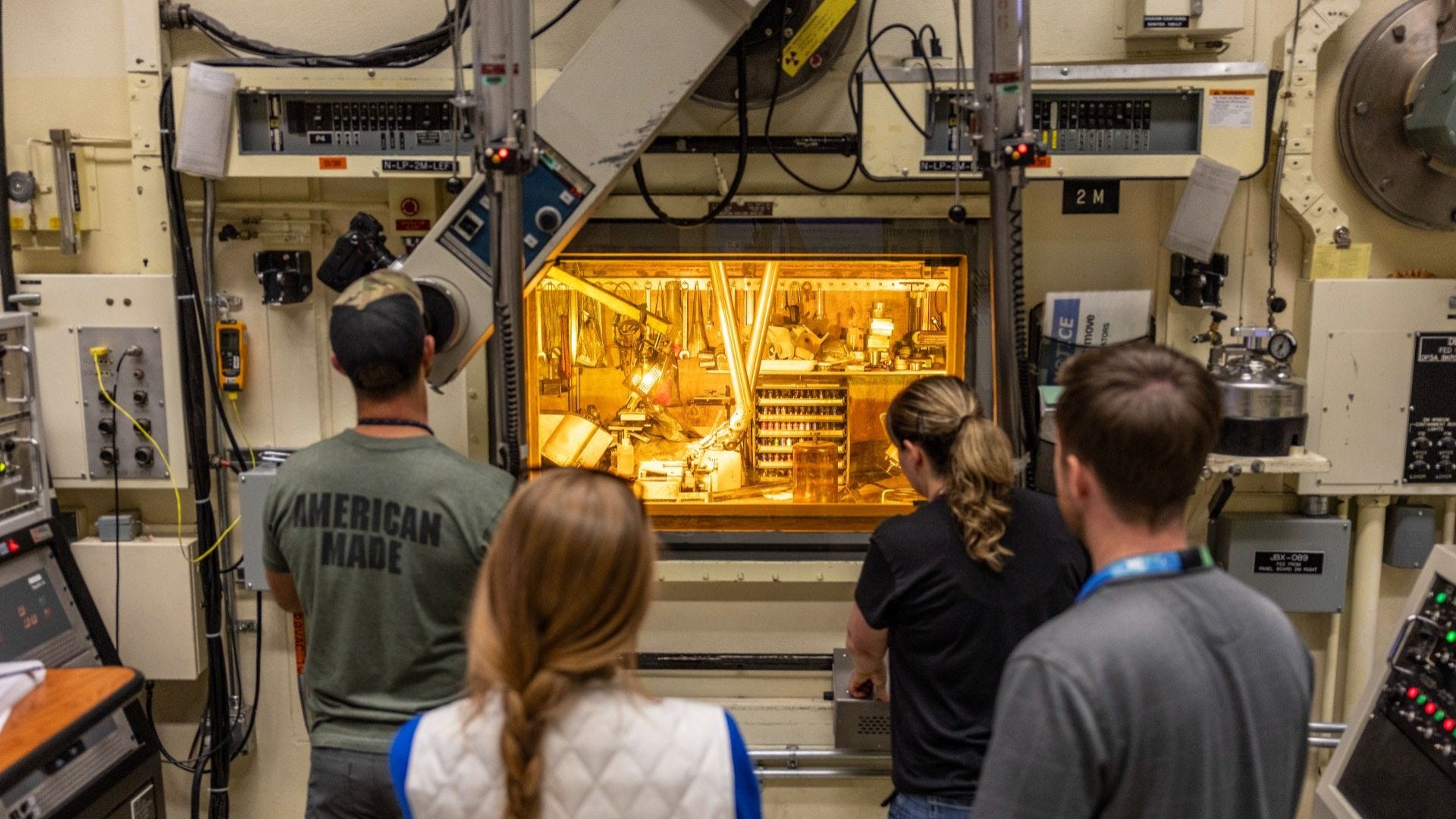
Aneel fuel rodlets undergoing irradiation examination at INL’s Hot
Fuel Examination Facility
US Nuclear fuel milestone: Thorium-uranium blend lasts 8 times longer than usual (T)
ANEEL ( Advanced Nuclear Energy for Enriched Life ) has successfully completed a multiyear irradiation test at the Advanced test Reactor at the Idaho National Laboratory. This new nuclear fuel made from combining thorium and enriched uranium exceeds the typical burnup of conventional nuclear fuels by more than eight times. ANEEL aims to deliver advantages of both thorium and uranium while extending the operational life of existing reactors. Incorporating thorium, which is abundant, it produces less waste than a uranium fueled reactor. Developed by Clean Core Thorium Energy (CCTE) it is intended for use in existing nuclear reactors including large pressurized water cooled units. It incorporates current geometry of fuel designs used in pressurized water reactors and in the Canadian Deuterium Uranium (CANDU) reactor. Not only does it promise improved fuel utilization but it offers enhanced safety characteristics, inherent proliferation resistance, and meaningful reductions in long-lived nuclear spent fuel radioisotopes.
2.
Upstart company plans to fuel “Nuclear Renaissance” by mining massive uranium deposit ( C )
A recent startup company, Eagle Nuclear Energy, has purchased rights to mine 7,500 acres of the McDermitt Caldera which has been identified as the largest uranium resource in the United
States. It has been evaluated to contain 38 million pounds of near surface uranium ore. This deposit is known as the Aurora Uranium Project. With the development of small nuclear reactors which is on the horizon there is a substantial emerging market for nuclear reactor fuel in the United States. Currently the U.S, ranks far behind other countries in uranium mining. The leaders are Kazakhstan which provides 39 % of the world’s supply, Canada with 24%, and Namibia with 12%. This initiative is viewed with enthusiasm by the U.S. Department of Energy Secretary Chris Wright.
3.
US nuclear firm to deploy multiple 390 MW reactors for 4 GW power under new deal ( C )
Terrestrial Energy has signed an agreement with Riot Platforms, a data center developer, to power its operations with Generation IV molten salt cooled reactors. Nuclear energy is expected to be the primary power in support of the growing AI expansion of operations that require large sources of uninterrupted energy. Riot has demonstrated its ability to construct complex digital systems while Terrestrial Energy has highly promising potential in the small nuclear field. Using standard low enriched uranium, Terrestrial Energy expects to generate 50 percent more power for the same reactor size while requiring less space.
4.
Are Trump’s nuclear plans illegal? (P)
Thirteen organizations have filed comments on May 10th with the Nuclear Regulatory Commission suggesting that recent initiatives by President Trump violate long-standing regulations. In a separate action 11 state attorneys general filed concurring motions that these initiatives violated existing law. The objectionable actions included proposals that ‘pilot’ reactors be excluded from NRC licensing and from environmental reviews. The proposed new regulations would exempt reactors, for which a unit of similar design had been approved, from review. They would also exempt military reactors from review.
5.
Solar and Wind set to surpass nuclear power in 2026 (P)
The International Energy Association announced that in 2026 both solar and wind power individually will surpass nuclear generation. Their combined output is expected to account for 19% of global electricity, up from 15% in 2024.
6.
Russian ship that sank near Spain may have been carrying nuclear reactors to North Korea (P)
A Russian ship that suffered a series of mysterious explosions before sinking off the south-east coast of Spain in December 2024 may have been carrying nuclear submarine reactors for North Korea. The Ursa Major was purportedly sailing from St. Petersburg to Vladivostok when it sank 62 nautical miles off the coast of Spain. Rescued crew members reported that there had been three explosions in the ship’s engine room. The ship exhibited damage consistent with torpedo damage. Limited information has been forthcoming as a result of an investigation conducted by the Spanish government. A Russian warship took charge of the event. The Russians appeared to have taken action to sink the Ursa Major. The ship was probably carrying nuclear reactors for North Korea. This could mark retaliation against North Korea as a result of their providing support for Russia in its war against Ukraine.
7.
10-MW nuclear reactor on truck bed: Power Bank for AI data centers (T)
A Chinese research team is testing a prototype of a 10-megawatt truck-mountable nuclear power bank that could act as a mobile, ultra compact power source for AI data centers, remote communities, emergency sites and maritime and space systems. It claims to be the world’s first such unit. It is being marketed as
ultra safe, ultra small, and ultra long-lasting.
8.
United States Completes Accelerated Mission to Remove Highly Enriched Uranium From Venezuela (P)
In partnership with the United Kingdom, the International Atomic Energy Agency, and Venezuela the United States removed highly enriched uranium from Venezuela’s shuttered RV-1 research reactor. The RV-1 was the country’s only nuclear reactor, originally obtained from the United States through the Atoms for Peace program. The material was transported by a specially designed ship from the United Kingdom and brought to the Savannah River site in South Carolina. The reactor, which was designed by a Venezuelan scientist, reached criticality in 1960 and was decommissioned in 1991. 13.5 kilograms of uranium enriched beyond 20 percent was removed.
9.
Rwanda to explore deployment of small nuclear reactors with US help (T)
Rwanda signed an agreement to explore development of nuclear energy with U. S. company Holtec International. They will explore the use of the SMR-300 The SMR -300 is under development by Holtec with plans to see construction in 2027. The design is an advanced passive safety light water reactor rated at 300 MegaWatt electric output. Gravity driven safety systems do not The U.S. government is supporting this initiative. The only operational nuclear reactor in Africa is currently in South Africa with units under construction by Russia in Egypt.
10.
Terrapower and HD Hyundai sign Natrium reactor agreements ( C )
Terrapower is moving optimistically with plans to follow up its first implementation of a Natrium reactor, now under construction in Wyoming, with construction of multiple units elsewhere. To support this initiative they have signed an agreement with South Korea’s HD Hyundai to collaborate on the design, manufacture, and construction of multiple enclosure systems units. The Natrium is a 345 Megawatt Electric sodium-cooled fast reactor with a molten salt-based energy storage system. Terrapower, whose co-founder is Bill Gates, also has an agreement with Facebook and Instagram’s owner Meta for up to eight Natrium plants by 2035. Terrapower is in a leadership position as a U. S. based generation IV nuclear reactor manufacturer.
11.
CGN Breaks Ground on Fourth Hualong One Reactor at China’s Taipingling Atomic Power Plant ( C )
China General Nuclear has started construction on the fourth Hualong One Reactor at the Taipingling project. There are six such plants planned for this location. Each will have an installed capacity of 1,200 megawatts electric energy. These pressurized third generation reactors have both active and passive cooling systems. This power plant, when fully operational, will be able to meet the demands of one million people.
12.
Russia signs $16.5 billion deal to build first nuclear plant in Kazakhstan ( C )
Russia on May 28, 2026 signed an agreement to build the first nuclear power plant in Kazakhstan at a cost of $16.5 billion partially paid for via a major export loan from Moscow. Construction is scheduled to begin in 2027 with the reactor becoming operational in 2034.
13.
Trump plan to give start-ups plutonium harvested from Cold War-era nuclear weapons is risky, experts say (P)
A Trump administration plan to provide plutonium from dismantled Cold War-era nuclear weapons to start up nuclear reactor companies is drawing criticism as being a national security threat.
There is a chance that the plutonium could be used to manufacture an improvised bomb. This Surplus Plutonium Utilization Program is intended to expand the ongoing nuclear renaissance. The Department of Energy has selected five companies to take part in the program. Critics have expressed doubts about the ability of small start-up companies to maintain plutonium in a secure fashion. Last September Democratic Senator Edward Markey of Massachusetts and two Democratic congressional representatives sent a letter to President Trump raising concerns over the risk to national security of this plan.
14.
Navy to test 100,000 ton aircraft carrier as floating nuclear power station (T)
The U.S. Navy is planning to explore the use of the USS Gerald Ford’s nuclear reactors to provide power to land-based facilities during port visits. This power could be used by military installations as well as by civilian systems in need of power during emergency situations. The engineering challenge is non-trivial. Naval shipboard power systems operate at frequencies and voltages that must be carefully synchronized with the land-based grid. The concept needs to be evaluated with respect to the scheduling plans for the port visit and the long term operational plans for the Gerald Ford which is expected to serve for another 50 years.