

Nuclear Tomorrow - March 2026
Nuclear Tomorrow is a newsletter that is issued monthly to identify press reports on developments in the field of nuclear energy. Topics are selected for their relevance to the impact of nuclear energy on global warming. The newsletter is written for members of the general public who are concerned with policy related to these issues. Postings are categorized as dealing with Technology (T), Policy (P), and/or Construction (C). In some cases registration or a fee is required to access an article. Hyperlinks are provided to connect newsletter posts to the referenced publication. (See hot buttons associated with each posting) The newsletter is intended to expand on topics included in the book, “Nuclear Energy: Boom, Bust, and Emerging Renaissance,” which has recently been published by Oxford University Press. The author of the book and of this newsletter is Edward A. Friedman, Emeritus Professor of Technology Management at Stevens Institute of Technology in Hoboken, New Jersey, USA. The book is available for purchase via the Oxford University Press Website. The following link provides access to the book:
https://global.oup.com/academic/product/nuclear-energy-9780198925781?lang=en&cc=gb#
NOTE - A 30% Discount is available using the code AUFLY30
for purchases through Oxford University Press
1.
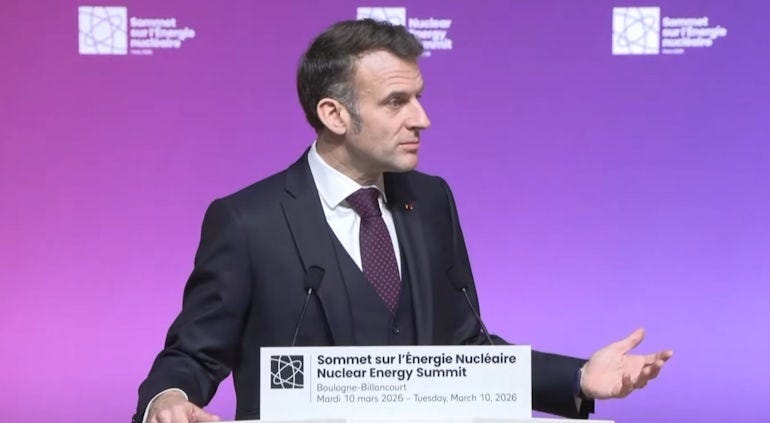
Macron Says Nuclear Key To Meeting Climate Goals And Powering Future Industries (P)
Emmauel Macron greeted those attending the Nuclear Summit that opened in Paris on March 10th. He stressed the challenges in financing nuclear energy and in attaining uranium independence
2.
A Nuclear Reactor Backed by Bill Gates Gets Federal Approval to Start Building ( C )
The Nuclear Regulatory Commission voted to grant a construction permit to Bill Gates’ company, Terrapower, to build the Natrium reactor in Kemmerer, Wyoming. The plant is expected to come online in 2031, This liquid sodium cooled reactor would replace a coal powered plant. This 345 megawatt electric reactor is about a third the size of a traditional reactor. Under the new streamlined review processes of the NRC the review was completed in 18 months compared with the past average of 24months. Edwin Lyman of the Union of Concerned Scientists has raised concerns about the speed with which this review was completed. He cited the inherent dangers of liquid sodium which has never before been used as a reactor coolant.
3.
‘World-first accelerator-driven nuclear reactor’
Nears as China eyes ‘1000-year’ energy source (T)
By combining a proton accelerator with a nuclear reactor into
a single combined system, a highly efficient energy output can be
achieved. The accelerator at the Chinese Academy of Sciences is used to impact a lead-bismuth alloy to create a massive flux of neutrons. These neutrons impact Uranium-238 in the reactor to convert much of it into Plutonium-239 which is usable reactor fuel.
Rather than self-sustaining nuclear reactions this hybrid system requires both the reactor and the accelerator to operate together.
China which achieved an operational accelerator-driven subcritical systemal system (ADS) in 2021 is on the verge of implementing a megawatt level system in 2027. A parallel undertaking is being pursued by the U.S. Department of Energy at the Thomas Jefferson National Accelerator Facility in Newport News Virginia. This program bombards a liquid mercury target with protons to produce the neutron beam. The U.S. program does not plan to build an operating system in the near future.
4.
Reducing Europe’s nuclear energy sector was a ‘strategic
Mistake’, EU chief says (P)
Ursula von der Leyen, the EU Commission President delivered the opening address at the IAEA Nuclear Energy Summit in Paris on March 10th. She pointed out that in 1990 Europe produced about a third of its electricity from nuclear but that had fallen to about 15%. She called this a mistake which occurred largely due to Germany eliminating nuclear reactors. This was an act that occurred while she was a minister in Merkel’s government. Today the EU does not directly fund nuclear energy projects because they are not supported unanimously by its 27 member governments. Von der Leyen said that the Executive Commission would offer a 200-million-euro guarantee for private investments in innovative nuclear technologies. She said that the funds would come from the EU’s carbon market. Austria and Luxembourg remain opposed to nuclear energy while other opposition is disappearing. Macron called for standardized reactor design across Europe.
5.
Greenpeace activists storm stage at France’s nuclear summit, confront Macron (P)
Two Greenpeace activists bhttps://www3.nhk.or.jp/nhkworld/en/news/20260311_05/roke onto the stage at the start of the global nuclear summit in France, interrupting President Emmanuel Macron and U.N. nuclear chief Rafael Grossi as they were greeting heads of state. One shouted at Macron, “Why are we still buying uranium from Russia?” Around 15 Greenpeace activists blocked arriving convoys outside the meeting venue.
6.
Macron calls for faster development of next-generation nuclear reactors (P)
President Macron spoke at the World Energy Summit in Paris where he stated that he intends to speed up the development of next generation nuclear reactors in order to enable greater energy
Independence. He reflected the urgency created by the Iran conflict that has precipitated an energy crisis.
7.
World’s first underground nuclear borehole drilling starts for US firm’s gravity reactor ( C )
Deep Fission has begun drilling the first of three data acquisition wells for its innovative ‘Gravity” reactor that is designed to operate a mile beneath the earth’s surface. The first well is bein drilled to a depth of approximately 6,000 feet with a diameter of eight inches. It is designed to obtain critical geological, hydrological and thermal data.
8.
Trump admin courts Westinghouse rivals amid slow talks on new nuclear (P)
Last October the U.S. Department of Energy announced that it was exploring the construction of 10 1200 Megawatt AP1000 reactors with Westinghouse Electric Company at a cost of $80 Billion. However, Westinghouse has a poor record for fabrication of this reactor at the Vogtle Electric Generating Plant in Georgia. The two plants that went online in 2023 and 2024 were seriously behind schedule and exceeded budgets by substantial amounts.
The pursuit of the Vogtle reactors precipitated Westinghouse being forced into bankruptcy in 2017. That action resulted in the takeover of Westinghouse by Brookfield Asset Management, a Canadian corporation. Given this history, it is not surprising that discussions between the U. S. Department of Energy and Westinghouse are moving slowly regarding specific plans for these AP1000 reactors. The U.S. Department of Energy has opened talks with GE Hitachi and the South Korean Electric Power Company regarding possible alternatives to the Westinghouse plan. The AP1000 and designs like it have made up 12 of the 14 new reactors connected to the worldwide grid since 2023. These discussions with GE Hitachi and South Korea Electric Power Company (KEPCO) raise other issues. GE Hitachi is fully engaged in 300 megawatt BWRX-300 reactors in Tennessee and in Ontario, Canada, while KEPCO is currently barred from nuclear construction in the United States. There is an ongoing dispute between Westinghouse KEPCO in which Westinghouse asserts that KEPCO has infringed on patent rights of the AP1000 in development of its APR - 14000.
9.
Webinar highlights Gen IV reactors (P)
The American Nuclear Society hosted a webinar entitled “Perspectives on Generation IV Reactors,” led by Edward A. Friedman, author of this Nuclear Tomorrow Substack. He reviewed the origins of nuclear energy, its early development, the
accidents that precipitated a hiatus in its progress and then the current phase of Generation IV developments. The Webinar can be viewed at the ANS cite : https://www.ans.org/webinars/view-genivperspectives/fuel
10.
Trump and Japanese PM Takaichi seal $40B nuclear reactor deal amid global energy shakeup (P)
President Trump and Japanese Prime Minister Takaichi signed a $40 Billion agreement for Japanese investment in GE Verona and Japan’s Hitachi to construct two BWRX-300 small modular reactors in Tennessee’s Clinch River facility and a site in Alabama. This is part of a larger joint initiative in which the two countries are advancing nuclear energy development to counter Chinese dominance in the nuclear arena.
11.
Next-gen nuclear has a chicken-and-egg problem (P)
A recent study by the consultancy Solestiss raises serious questions about plans for large scale expansion of nuclear energy in the United States. It cited four active programs that are currently underway: TerraPower, Holtec, GE-Hitachi, and Westinghouse. Future plans for these initiatives project hundreds of reactors being built in the coming years. The study points out that large scale expansion is likely to encounter bottlenecks in fuel availability, skilled personnel, and critical components. Exacerbating these shortages is the existence of many designs, in addition to these four, that have plans to compete in this marketplace. The report urged that the U.S. Department of Energy place more emphasis on the capacity to scale up as it
promotes new designs.
12.
Lai Administration Reverses Course on Nuclear Energy (P)
Lai Chiang-te, President of Taiwan since 2024, has reversed course with respect to nuclear energy. On March 22 he announced plans to restart two nuclear power plants in Taiwan.
His party has previously been anti-nuclear. It will take several years to bring these reactors back online.
13.
Microsoft Corp is expanding its AI ambitions through a new partnership with Nvidia Corp (P)
Microsoft announced on March 24th that the company and Nvidia are teaming up to work across the nuclear energy lifecycle, aiming to speed up permitting, design, construction and operations through the strategic use of AI. This approach replaces fragmented workflows with a connected system that makes projects more predictable and easier to manage.
14.
Vietnam, Russia sign agreement on new nuclear plant ( C )
Russia and Vietnam have signed an agreement for construction of two VVER-1200 reactors. The announcement stated that this initiative will give a strong impetus development of cooperation in adjacent areas of high technology and fundamental applied research. The head of Russia’s Rosatom company stated, “We see this as the foundation for a long-term industrial partnership…” Currently, Vietnam operates a Russian designed research reactor for which Russia supplies Vietnam with fuel and medical isotopes.
15.
NRC Unveils First New Reactor Licensing Process in Decades to Speed Deployment While Maintaining Safety (P)
The Nuclear Regulatory Commission has issued a new licensing pathway. The changes are expected to reduce unnecessary duplication in reviews, allow developers to complete licensing in stages, establish clearer, more predictable pathways to approval, and significantly reduce the time and cost required to bring new reactors online. This is the first new set of regulations to address initial reactor licensing since 1989.
16.
New US Company plans uranium conversion facility ( C )
FlexPoint Energy was launched with a mission of establishing a fully American, vertically integrated nuclear fuel capability. Based in Houston, Texas and McLean, Virginia it aims to support US energy independence, enable advanced reactor development and strengthen national security. They will convert uranium oxide yellowcake into gaseous uranium hexafluoride.