

Nuclear Tomorrow - July 2026
Nuclear Tomorrow is a newsletter that is issued monthly to identify press reports on developments in the field of nuclear energy. Topics are selected for their relevance to the impact of nuclear energy on global warming. The newsletter is written for members of the general public who are concerned with policy related to these issues. Postings are categorized as dealing with Technology (T), Policy (P), and/or Construction (C). In some cases registration or a fee is required to access an article. Hyperlinks are provided to connect newsletter posts to the referenced publication. (See hot buttons associated with each posting) The newsletter is intended to expand on topics included in the book, “Nuclear Energy: Boom, Bust, and Emerging Renaissance,” which has recently been published by Oxford University Press. The author of the book and of this newsletter is Edward A. Friedman, Emeritus Professor of Technology Management at Stevens Institute of Technology in Hoboken, New Jersey, USA. The book is available for purchase via the Oxford University Press Website. The following link provides access to the book:
https://global.oup.com/academic/product/nuclear-energy-9780198925781?lang=en&cc=gb#
NOTE - A 30% Discount is available using the code AUFLY30
for purchases through Oxford University Press
Canada wants up to 10 new nuclear reactors in 15 years, betting on an old design to shape its grid- P
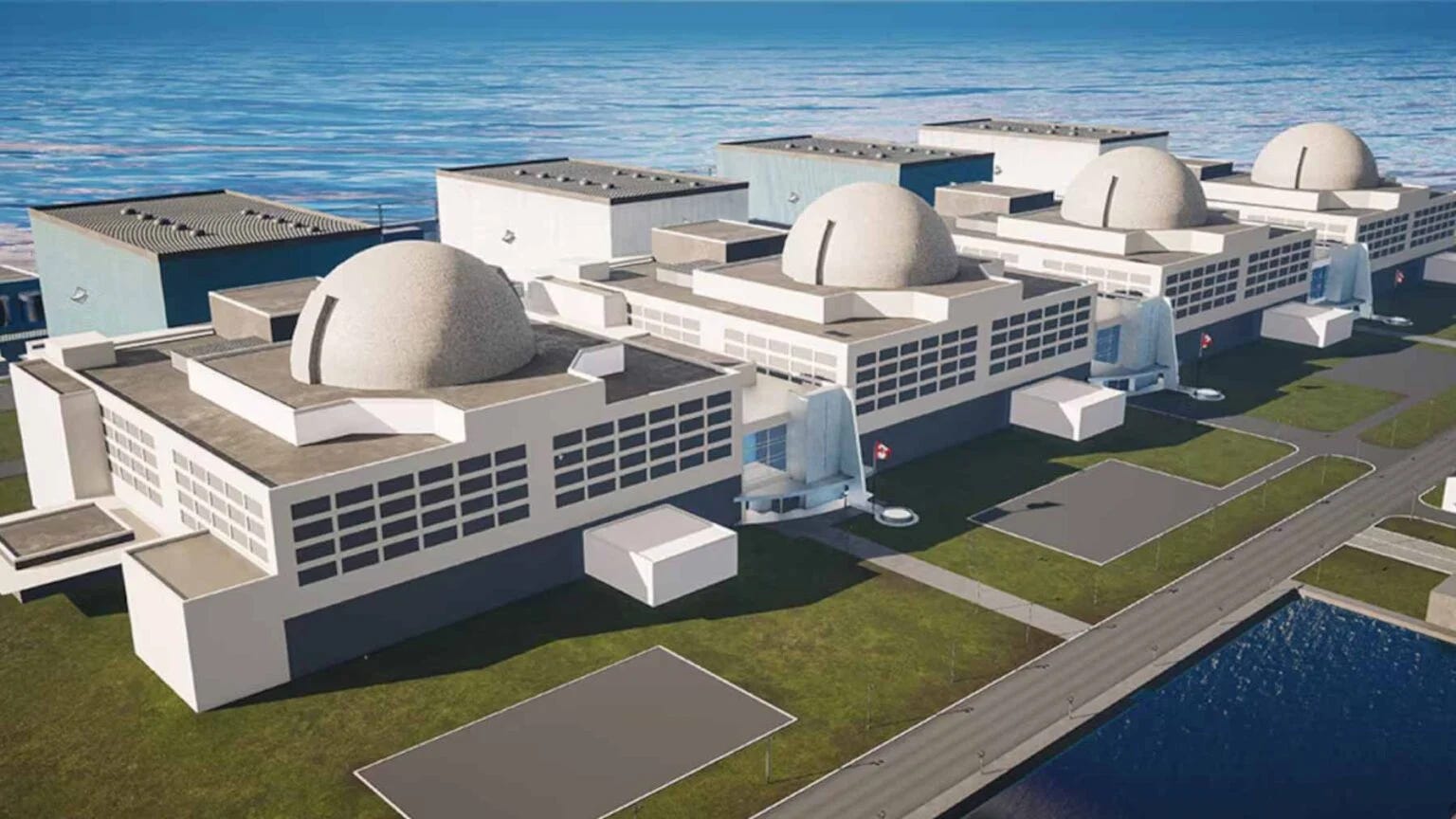
The Canadian government plans to expand economic opportunities afforded by its nuclear technology capabilities. They wish to use more clean power at home and for export and to expand uranium exports. Plans call for two large scale reactors under construction by 2035 and to have five more under development by 2040. Canada CANDU rectors are currently operating in six countries with 17 in Canada and nine abroad. The new strategy seeks to have 4 new international reactors by 2040 and six to ten over 15 years.
Canada currently produces 24 percent of global uranium output in 2024 and to double uranium exports by 2035.
2.
US moves to eliminate long time radiation safety principle for nuclear power - P
The Nuclear Regulatory Commission (NRC) proposed elimination of a long time requirement that radiation levels should be “as low as reasonably achievable,” (ALARA). Proponents seek dose levels that are less subjective while advocates of the existing requirement note its positive impact on safety. Edward Lyman, director of nuclear power safety at the Union of Concerned Scientists noted that , “this is opening the door to sloppier practices and worse management.”
The NRC is proposing other changes including a radioactive exposure limit that now allows an estimated 4 fatalities for every 10,000 people exposed to increase to a maximum allowable radiation for 70 years of 9 fatalities.
3.
U.S. company plans $1.2 billion Argentinian nuclear reactor - C
The government of Argentina has announced plans to build a new nuclear reactor at the country’s largest nuclear complex at Atucha. The project, led by U.S. based Meitner Energy, calls for a $1.2 billion investment, to construct the Argentinian designed ACR-300 Generation III+ small modular reactor using pressurized water technology with a generating capacity of about 300 megawatts of electricity. This will be the first commercial deployment of this technology. Construction is anticipated to take five years following the receipt of government approvals.
4.
Department of Energy Celebrates Fourth Criticality Ahead of July 4th Goal - T
U.S. Department of Energy challenged companies to demonstrate criticality of original designs with zero output power by July 4th, 2026. A fourth company has done so. The fourth was the Aalo Atomics test reactor, Aalo-X. In June, Antares Nuclear’s Mark-0 Reactor, Valar Atomic’s Ward 250, and Deployable Energy’s Unity achieved criticality.
These four reactors achieved criticality at national labs where it was not necessary to obtain safety approvals and where assistance for lab personnel was available. However, to keep on a fast track to development of new reactors each will require financing that is not yet available.
5.
Summary from Claude of NRC 2026 changes in regulations - P
NRC regulation changes summary
Here’s the summary of the NRC’s 2026 regulatory overhaul:
1. Part 53 — the headline change (final rule, effective April 29, 2026)
The first entirely new reactor licensing framework since 1989 (Part 52), and the first major rewrite since the 1956 Atomic Energy Act-era Part 50:
Technology-inclusive: applies to any reactor type, not just light-water reactors — opening the door for SFRs, MSRs, HTGRs, microreactors, etc.
Risk-informed/performance-based: relies on Probabilistic Risk Assessment (PRA) rather than prescriptive, LWR-specific design rules.
Optional pathway: Parts 50 and 52 remain available — developers now choose among three licensing tracks depending on technology maturity and risk tolerance.
Siting flexibility: relaxes the historic preference for remote, low-population-density sites.
Modernized ISI/IST: allows non-nuclear-specific commercial codes and standards for in-service inspection/testing instead of mandating ASME-only standards.
Emerged from the 2019 Nuclear Energy Innovation and Modernization Act (NEIMA) mandate, after six years of rulemaking and 150+ public comments.
2. Adjudicatory/hearing process reform (proposed March 3, 2026, comment period closed April 2)
Aimed at compressing contested licensing hearings:
Evidentiary hearings would start earlier in the process, right after a challenge is admitted.
Target: complete adjudications in 8–14 months rather than dragging out over years.
Projected savings: ~$51.7 million over five years (2026–2030).
Applies to both new reactor applications and license renewals.
3. Leveraging prior DOE/DoD reactor authorizations (proposed rule, comments closed May 4, 2026)
Would let applicants cite prior Department of Energy or Department of Defense authorizations of demonstration reactors as evidence of safety functioning — a new third option under §50.43(e), with a parallel provision under Part 53. Intended to reduce duplicative review work.
4. New Part 57 (proposed) — microreactors
A dedicated framework, “Licensing Requirements for Microreactors and Other Reactors with Comparable Risk Profiles,” in development as a separate track for high-volume, small-scale licensing.
5. Reactor Oversight and organizational reform (adopted March 30, 2026)
Updates to the Reactor Oversight Process are expected to reduce baseline inspection hours at operating plants by 38%, by eliminating redundant procedures and refocusing on risk-significant safety attributes. The NRC also launched an organizational restructure, creating three “business lines” — new reactors, operating reactors, and nuclear materials and waste — each integrating licensing and inspection functions under a single point of accountability.
Bigger picture: The NRC is executing more than two dozen rulemakings mandated by EO 14300, with proposed rules front-loaded between March and May 2026, and a cluster of final rules targeted for September–Novembegyr 2026 — arguably the most ambitious modernization of U.S. nuclear regulation since the atomic age began.
6.
Beijing’s evolving carbon road map balances climate targets and energy security - P
The State Council, China’s cabinet released a five year plan on July 8, 2026 to peak carbon dioxide emissions by 2030. The goal for carbon neutrality is 2060. The plan is comprehensive including buildout of wind, solar, hydro, and nuclear and the replacement of fossil fuels in areas like transportation. Emission reduction programs will be monitored at local levels.
7.
France temporarily shuts down three nuclear reactors over heat - T
France’s power authority announced on July 12th that three nuclear reactors have been temporarily shut down, while eight others are operating at reduced power. The measure is an environmental protection requirement to avoid discharging too much hot water into rivers already warming from the heatwave.
8.
US company seeks to produce uranium for nuclear energy from seawater - T
Texas based SuperCritical Materials Corporation has received an exclusive license from the U. S. Department of Energy to extract uranium from seawater. They have demonstrated that this can be done but needs to show that it cshipan be a commercial process.The company hopes to produce 1.85 million pounds of uranium per year for at least 40 years. That amount could power 4 million households annually.
9.
Korean Containership with Molten Salt Reactor Gets ABS Approval - C
Samsung Heavy Industries has been granted approval for its design on a containership powered by a molten salt reactor.
This fuel has the safety feature of hardening if the process failed. The design incorporates the use of two small modular reactors. The American Bureau of Shipping (ABS) granted basic design approval. Careful attention was paid to shielding the crew from radiation.
10.
China just lit a full-sized reactor that beat the small modular one next door to first criticality, on the same island, a fence between them - and the small one, 216 days late, costs two and a half times more per megawatt to build - C
On the coast of Changjiang, on the island province of Hainan, two reactors started construction 104 days apart, One is the Linglong One, a 125 megawatt small modular reactor the other is a full size Hualong One with ten times the output. While concrete for these two reactors was poured in the second half of 2021 the large reactor went into operation in July 2026 while the small reactor is still under construction. This comparison demonstrates the difference between construction of proven design and that of a first case. Not only is the small reactor significantly behind the schedule of the Hualong One, the cost of a megawatt of power from the small reactor is likely to be two and one half times greater than the cost of the larger reactor.
11.
China goes bold, unveils roadmap to make nuclear energy systems more intelligent - P
At the World Artificial Intelligence Conference in Shanghai in July 2026, Chinese scientists unveiled a roadmap for integration of AI with nuclear engineering. Dubbed AI for Accelerator-Driven Advanced Nuclear Energy Systems (ADANES) the goal is to integrate nuclear fuel breeding, spent fuel transmutation, and power generation into a single platform. The aim is to develop a system that embeds AI into the full life cycle from design and commissioning to operation and maintenance.
12.
US firm Holtec bets big on small modular reactors in IPO - P
The 40 year old Holtec filed for an IPO in which a bright future is predicted for small modular reactors. While there has been a great deal of speculation along these lines, these predictions await validation. In its IPO Holtec asserts: “SMRs will offer scalable, cost-effective solutions for new capacity with enhanced safety features, reduced production timelines and reduced land and transmission infrastructure…” It notes that a single SMR unit will need only 15 acres of land and will take a mere three tears to build. Holtec plans to deploy two SMRs at the Palisades Plant that it is restoring and may build two at the Oyster Creek site in New Jersey.
13.
Nuclear Energy Revival Puts Westinghouse in Prime Position - P
While more than half of the world’s existing reactors are based on Westinghouse technology the firm filed for bankruptcy in 2017 and was acquired by Brookfield Asset Management a New York Investment firm and Cameco, a Canadian uranium mining and enrichment company in 2023. There is a great deal of speculation about the possible role that Westinghouse might play given the resurgence of nuclear energy. While the Trump administration has put forward a $17.5 billion loan program for nuclear construction, there has not been any takers to date. Also, the possibility of Saudi Arabia engaging in reactor development, which briefly looked likely, has faded.
14.
Can the US Resurrect A Nuclear Power Plant - C
This report provides an overview of the efforts by Holtec International to reopen the Palisades reactor in Michigan. This 800 Megawatt electric pressurized water reactor was opened in 1971 and closed in May 2022. Its owner Entergy made a decision to exit the nuclear sector despite its license to operate the Palisades reactor until 2031. Entegy sold the reactor to Holtec International for decommissioning, however Holtec pursued an initiative to return the plant to operational status. In 2024 the US Dept of Energy closed a $1.52 billion loan to finance the restoration with a goal of keeping the plant operating until 2051. However, as Holtec began pursuing this restart it discovered hidden maintenance issues. There were cracks in the steam generator and a new fuel handling system needed to be installed, among other issues. Projected completion dates have been pushed back from 2025 and are approaching a deadline in 2027.
Holtec is making a transition from a decommissioning nuclear company to an operational company and is planning an IPO to finance this development. Plans are moving forward to raise $2 billion but no date has been set for a launch. It appears that that might be contingent on progress with the Palisades rehabilitation.
Local opposition has arisen at the Palisades site which has not impeded that work to date.
15.
No, the United States does not need a costly national cancer study near nuclear reactors - P
In December 2025, researchers led by Yazan Alwadi at Harvard’s T.H.Chan School of Public Health published a paper in heEnvironmental Health that claimed to find that cancer incidence increased for people living closer to nuclear power plants in Massachusetts. That paper and another similar study have been declared wrong by scientists from the Breakthrough Institute with detailed arguments appearing in the Bulletin of Atomic Scientists.
They site failure to provide a control group and using an improperly sampled group in the Harvard study. The Harvard study is called not only wrong but dangerous since it could lead the public to eschew nuclear power and to increase adoption of fossil fuels that are known carcinogens. It is pointed out that radiation from nuclear plants is orders of magnitude lower than that from medical imaging or a long airline flight. They also point out that the Harvard authors neglect other sources of radiation, most notably radon, that are found in natural background. It should be noted that the Harvard study has been cited by those opposing the reopening of the Palisade nuclear plant in Michigan.
It is hard to understand how such bad science has been promulgated by such a prestigious institution.
16.
Concern persists as former Three Mile Island nuclear plant progresses toward 2027 restart T
Unit 1 at the Three Mile Island site, which was not damaged in the TMI accident, but was closed down in 2019 for economic reasons and is now being reopened, was the topic of a public forum for the local community on July 29, 2026. Plans for restart in 2027 were discussed and reported to be on schedule. There was a focus in discussions about response planning to a radiological emergency.
Waste storage and removal plans were also discussed. Concern was expressed about the ability of the NRC to interface with this project due to staff reductions. Overall, the project is moving ahead as planned.