

Nuclear Tomorrow - February 2026
Nuclear Tomorrow is a newsletter that is issued monthly to identify press reports on developments in the field of nuclear energy. Topics are selected for their relevance to the impact of nuclear energy on global warming. The newsletter is written for members of the general public who are concerned with policy related to these issues. Postings are categorized as dealing with Technology (T), Policy (P), and/or Construction (C). In some cases registration or a fee is required to access an article. Hyperlinks are provided to connect newsletter posts to the referenced publication. (See hot buttons associated with each posting) The newsletter is intended to expand on topics included in the book, “Nuclear Energy: Boom, Bust, and Emerging Renaissance,” which has recently been published by Oxford University Press. The author of the book and of this newsletter is Edward A. Friedman, Emeritus Professor of Technology Management at Stevens Institute of Technology in Hoboken, New Jersey, USA. The book is available for purchase via the Oxford University Press Website. The following link provides access to the book:
https://global.oup.com/academic/product/nuclear-energy-9780198925781?lang=en&cc=gb#
NOTE - A 30% Discount is available using the code AUFLY30
for purchases through Oxford University Press
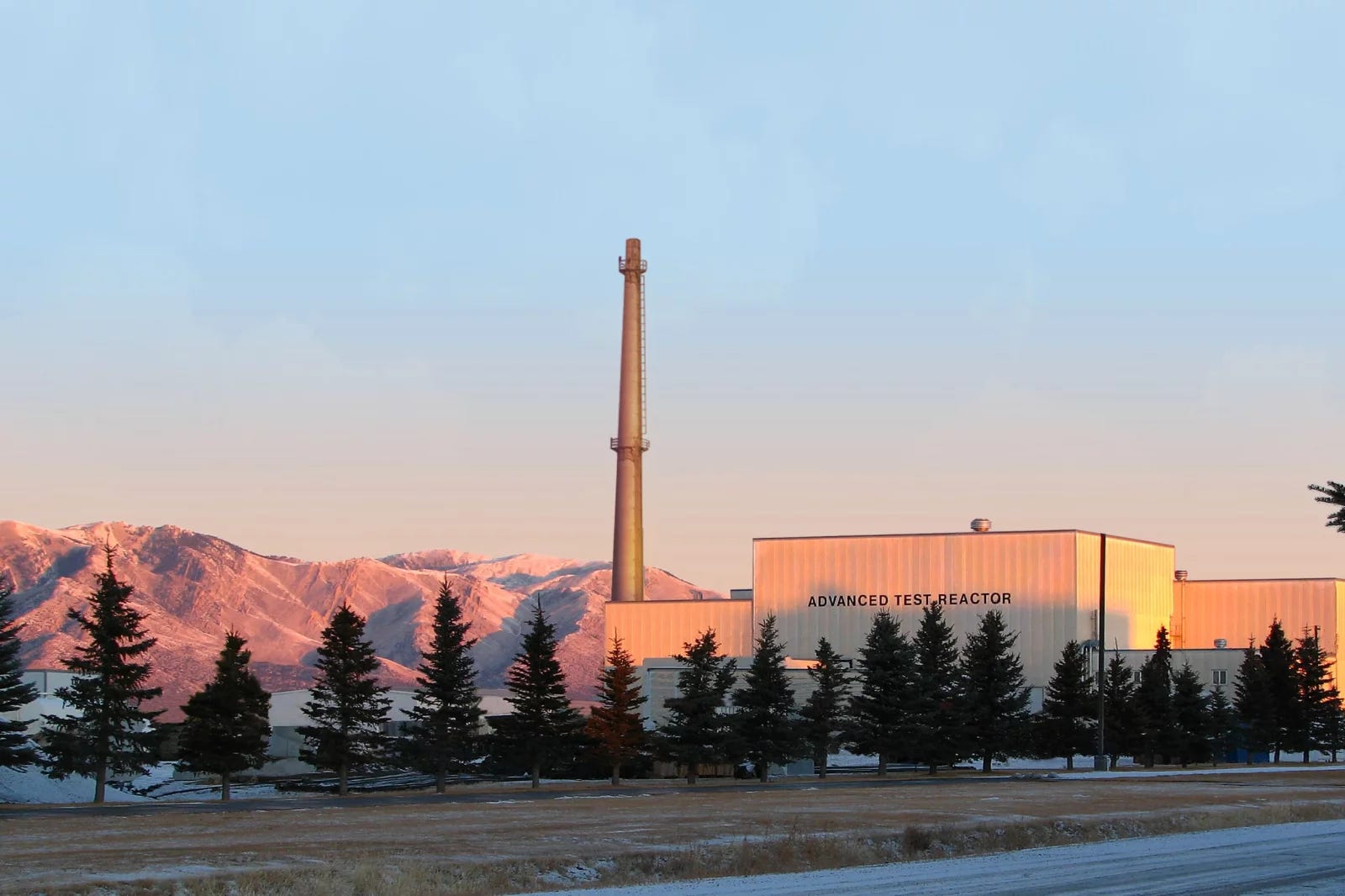
The Trump administration exempts new nuclear reactors from environmental view (P)
The Trump administration has revised environmental safety and security rules to expedite nuclear reactor construction without public review or discussion. Environmental impact statements will no longer be required when advanced nuclear reactors are built at Department of Energy sites. This action has elicited significant statements of disapproval from citizen organizations including the Union of Concerned Scientists. This action takes place as the Department of Energy funds 10 startups with the objective of seeing at least three of these become operational by July 4 of 2026.
2.
UK GOVERNMENT - ADVANCED NUCLEAR FRAMEWORK (P)
UK GOV - Advanced Nuclear Framework
The UK Government’s Advanced Nuclear Framework, published in February 2026, creates an enabling policy environment for private sector investment in advanced civil nuclear projects. It represents part of what the government calls a nuclear “golden age,” aiming to position Britain as a global leader in next-generation reactor technologies while creating thousands of jobs.
The Framework consists of two parts: Part One introduces the UK Advanced Nuclear Pipeline and Project Readiness Assessment process, enabling strong projects to access early engagement and potential future support; Part Two outlines enabling conditions including regulation, planning, skills, supply chain, and fuel requirements.
Developers submit applications across five core areas: technology status, developer capability, financing plans, siting, and operator arrangements. Successful applicants receive in-principle government endorsement, potentially unlocking discussions on revenue support and engagement with the National Wealth Fund as a catalytic investor.
Eligible projects must support land-based, non-mobile fission technologies that are small, advanced, or micro modular reactors using uranium fuel, be located in England or Wales, and commence construction within 10 years. A dedicated concierge-style business engagement unit helps developers navigate UK regulations and attract investment.
Large scale nuclear technologies are not included in this Framework though the government continues to support Gigawatt scale nuclear power.
3.
Our Clean Nuclear Future Has a Labor Problem (P)
As the United States enters a period of increased use of nuclear energy, this article reviews past practices regarding the exposure of workers to high radiation levels. It cites situations where workers were rotated in and out of intense radiation zones for as little as a few minutes. While there is a need to have safe policies regarding worker exposure, this article expresses concern that the Trump administration seems to be moving in the opposite direction.
4.
Nuclear startup TerraPower is moving fast. Some say too fast. ( C )
Bill Gates’ company TerraPower is building a sodium cooled nuclear reactor in Kemmerer, Wyoming. It anticipates receiving a license to build from the Nuclear Regulatory Commission during the first quarter or 2026. Edward Lyman of the Union of Concerned Scientists sees this NRC processing, which is proceeding on a fast track due to pressure from the Trump administration, as being reckless. This stage of approval is taking place eight months faster than anticipated. Lyman notes that sodium cooled reactors have had a history of fires. These have been experienced in Japan and in Russia.
5.
US Pledges $9 Billion Investment in Armenia Nuclear Power (P)
Vice President Vance signed an agreement with Armenia pledging up to $9 Billion for investment in nuclear energy. This envisions up to $5 billion in U.S. exports plus an additional $4 billion in fuel and maintenance contracts. Plans are expected to be formulated by mid 2026.
6.
Nuclear central in France’s latest energy strategy (P)
The French government has published its third Multiannual Energy Programme setting out plans for 2026-2035. It calls for the construction of six new reactors and the extended operations of existing plants. It envisions 60% of energy being decarbonized by 2030 and 70% by 2035. This would entail extending the lifetime of some existing reactors to 50 and in some cases 60 years. While this is a plan rather than legislation it will now be used as a framework for actions going forward.
7.
Russia pushes back hard against prospect of US-built nuclear plant in Armenia (P)
Several senior Soviet officials have spoken out against plans for the U.S. to build a nuclear reactor in Armenia. They have asserted that the U.S. technology is not fully proven and not suitable for the Armenian environment. The Soviets have found this intrusion of American influence in Armenia unsettling.
8.
US conducts first air transport of nuclear microreactor in bid to show technology’s viability ( C )
The US Department of Energy and the Defense Department jointly transported a small nuclear reactor on a cargo plane from California to Utah to demonstrate the viability of microreactors to
provide energy at remote bases. The reactor which was shipped in a C-17 is a little larger than a minivan. It can provide up to 5 Megawatts of electricity. Critics assert that this use of reactor technology is not cost effective and that it does not take into account management of the nuclear waste.
9.
US seeks to boost nuclear energy ties in Slovakia, Hungary (P)
Secretary of State Marco Rubio visited Slovakia and Hungary. In Slovakia he signed an intergovernmental agreement to begin US funding for a front end design study for a Westinghouse large reactor. This 1,200 Megawatt electric reactor is planned for operation in the 2040-41 time frame. Separately, he signed an agreement in Budapest, Hungary for exploration of construction of small modular reactors with GE Verona Hitachi of BWRX-300 reactors. The BWRX-300 is a boiling water reactor with multiple passive safety features.
10.
Markey Statement On Trump Caving To The Saudis on Nuclear Nonproliferation (P)
Senator Edward Markey of Massachusetts released a statement on February 20th calling on Congress to reject a deal between the US and Saudi Arabia that would allow Saudi Arabia to enrich uranium. Markey is concerned that this could lead to nuclear weapons development by Saudi Arabia. The US and Saudi Arabia negotiated a deal in December, 2025 on civil nuclear cooperation, but key details on the issue of whether Saudi Arabia will be permitted to enrich uranium remain unclear.
11.
AP1000 training centre opened in Madrid ahead of European Fleet (T)
On February 17 Westinghouse opened a full-sized replica of a control room at a new AP1000 Training Centre in Spain as the company prepares for construction of 14 or more units across Europe in coming years. Training needs to be started about five years before plants become operational. There are contracts for nine AP1000s in Ukraine, Poland with three, and two in Bulgaria. They also anticipate building six units in India.
12.
American Nuclear Society responds to deeply flawed study on nuclear plant proximity (P)
The American Nuclear Society (ANS) responded to a recent study published February 23, 2026, in Nature Communications which purported to show an association between residential proximity to nuclear power plants and elevated cancer mortality rates. The ANS response points out that the study deals only with proximity
and does not include any dose assessments. It also fails to control for multiple environmental variables and socioeconomic factors. The ANS response asserts that the Nature Communication study is deeply flawed.
13.
RUSSIA and UKRAINE agree local truce to allow repairs at Europe’s largest nuclear power plant ( C )
Russia and Ukraine agreed to a local ceasefire to allow repairs of the backup power lines to the Zaporizhzhia nuclear plant. Deming activities are ongoing to ensure safe access for the repair teams.
14.
France’s new Energy Law slashes Renewable Targets, Eases Pressure on EDF (P)
France has passed a new law on energy that reduces its wind and solar targets and removes the mandate for EDF -the state owned firm- to close nuclear plants. It reverses an earlier legal mandate that required 14 reactors to close. The new 10 year plan aims to increase nuclear electric production by 5%. The far right calls for a vote of no confidence in response to this action.
15.
Denison builds Canada’s first new type of uranium mine ( C )
Canada’s first new large-scale uranium mine in over 20 years moves forward. With construction anticipated to take approximately two years, work is scheduled to commence in March in northern Saskatchewan. This will be the first use in Canada of in situ recovery (ISR) mining, a technique that has been used previously in the United States. ISR mining injects a solution into underground wells, separates uranium from the ore and pumps it to the surface for extraction. This process is less expensive than hard rock mining, doesn’t require the digging of large pits and leaves fewer tailings. Construction is shorter than conventional mines because ISR does not require one handling, crushing, and grinding infrastructure.
Thank you professor Friedman for your informative news compilation with your balanced comments.