

Nuclear Tomorrow - August 2026
Nuclear Tomorrow is a newsletter that is issued monthly to identify press reports on developments in the field of nuclear energy. Topics are selected for their relevance to the impact of nuclear energy on global warming. The newsletter is written for members of the general public who are concerned with policy related to these issues. Postings are categorized as dealing with Technology (T), Policy (P), and/or Construction (C). In some cases registration or a fee is required to access an article. Hyperlinks are provided to connect newsletter posts to the referenced publication. (See hot buttons associated with each posting) The newsletter is intended to expand on topics included in the book, “Nuclear Energy: Boom, Bust, and Emerging Renaissance,” which has recently been published by Oxford University Press. The author of the book and of this newsletter is Edward A. Friedman, Emeritus Professor of Technology Management at Stevens Institute of Technology in Hoboken, New Jersey, USA. The book is available for purchase via the Oxford University Press Website. The following link provides access to the book:
https://global.oup.com/academic/product/nuclear-energy-9780198925781?lang=en&cc=gb#
NOTE - A 30% Discount is available using the code AUFLY30
for purchases through Oxford University Press
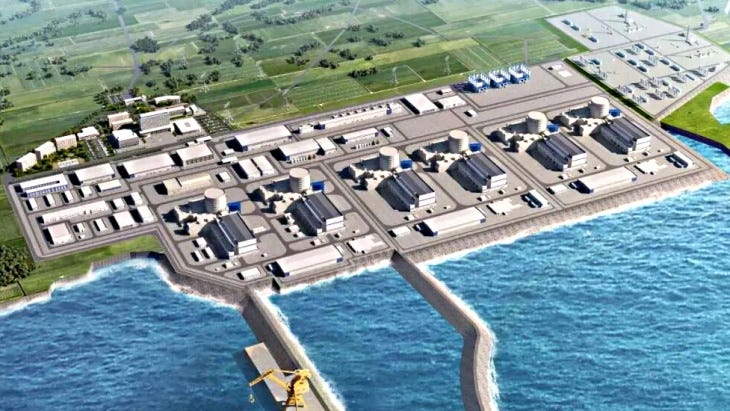
How the New Zhuanghe plant could look with 6 units
China approves construction of eight more reactors ( C )
The construction of three pairs of Hualong One reactors (HPR 1000) as well as two Guohe One (CAP1400) reactors have been approved by the State Council executive on July 31, 2026. 10 Hualong One units are commercially operational with another 37 approved for construction. The Guohe One reactor is an enlarged version of the CAP1000 pressurized water reactor developed from the Westinghouse AP1000
Scorching heat is straining Europe’s nuclear power supplies - and prompting drastic measures (P)
A hot and exceptionally dry summer has disrupted Europe’s power plants with severe impacts in France, Hungary, and Romania. The water levels have dropped significantly in the Danube river causing reductions in power levels and shutdowns that have never before been experienced. France has experienced massive jellyfish swarms that along with wildfires and draughts have caused shutdowns of reactors. These events are causing an economic decline that is likely going to get worse.
Taiwan’s Nuclear Reversal (P)
The phase-out of nuclear power in recent years has left Taiwan vulnerable to global supply shocks and challenged to meet the fast-growing, AI-driven energy needs of its tech sector. The government is now considering restarting two shuttered nuclear plants. This is a stunning political turnaround for the ruling Democratic Progressive Party. The last nuclear plant was closed in May 2025. Taiwan imports about 97% of its energy and is extremely vulnerable to disruptions in energy supplies. While planning to decommission their two remaining reactors these power plants have remained in a shuttered but operational state. Due to its frequent cloud cover and haze, solar power operates at only 15% of its nameplate capacity.There is continuing controversy regarding the safety of these reactors as well as unresolved issues regarding waste management.
Plans for nuclear-powered merchant ships must confront risks (P)
In the quest to reduce greenhouse gases, the use of nuclear reactors to power shipping is receiving increased attention. Nuclear powered shipping frees up space reserved for other forms of fuel, thus expanding the volume of cargo that can be transported. It also eliminates times devoted to refuelling. However it opens vulnerability to being hijacked, running aground or coming under missile attack. Both the International Atomic Energy Agency (IAEA) and the International Maritime Organization (IMO) are launching programs to update regulations for nuclear powered shipping. Reactor powered ships require licensing, insurance, crewing, upkeep, port acceptance, emergency preparedness and support for decommissioning. Given plans to utilize innovative generation IV designs discussions need to be held and consensus on regulations needs to be pursued
Detecting the Illicit Removal of Nuclear Fuel (T)
At the Chooz nuclear power plant in France studies are being pursued to monitor the uranium in spent fuel pools through the observation of anti-neutrinos. Due to the fact that neutrinos pass through all forms of matter, the fuel can be monitored without having direct access. These observations can provide real time tracking of unauthorized fuel changes, undeclared plutonium production or any attempt to divert material.
Kansans are up in arms over an underground nuclear site (P)
The nuclear start-up Deep Fission is moving ahead with plans to install a reactor deep underground in Parsons Kansas. This pressurized water reactor would be one mile below the surface reducing the cost and complexity of above ground reactors. Residents are raising concerns about the safety of the design which is proceeding under oil and gas drilling regulations rather than concerns that explicitly address nuclear issues. Water would be placed over the reactor as a coolant. It is anticipated that the reactor would go online in 2027 or 2028. Residents are also concerned that the White House is allowing reduced attention to safety concerns.
Next-gen molten salt reactor designed to generate 300 to 500 MWe from Nuclear Waste ( C )
Nuclea Energy has purchased the entire technology catalog of Moltex Energy. Of particular interest is the process Moltex developed known as Waste to Stable Salt. The WATSS process converts used uranium oxide fuel into molten salt reactor fuel. This is done through chemical processing that has been validated. This technology is expected to be deployed in the mid- 2030s.
8. How sinking 260-feet barges could keep a 2,000MW
nuclear plant operational ( C )
To keep a nuclear plant on the Danube operating the government of Hungary is sinking to barges that will raise the water level several feet. This is a temporary solution that will allow the reactor to keep operating while a dam is built that will create a new water level on a more permanent basis.
9. Port of Long Beach signs deal to build small offshore nuclear reactors ( C )
The Port of Long Beach California has signed an agreement for the construction of small offshore nuclear reactors with Bluecore Energy. The plan, which is in an early phase, envisions a 10 MWe water cooled reactor on a barge in the
Harbor. Bluecore is a startup with plans to eventually build multiple units to power port activities.
10. Apollo Atomic wants to make nuclear power cheaper by shrinking an overlooked part ( C )
Apollo Atomics redesigned the steam generator for nuclear reactors with the result of 40 times smaller size compared with a conventional steam reactor. This is achieved by taking into account the much greater energy density of nuclear reactors compared with coal and gas heating plants upon which the design of steam generators are currently based. Instead of processing water through tubes surrounded by water, Apollo uses a compact metal block with needle thin channels. This allows a 40 times smaller reactor design that will allow reactors to be assembled in factories rather than on site. Apollo expects to be able to build a 300 megawatt reactor in less than 24 months. To date, Apollo has built a 40 kilowatt demonstration reactor.
11.
Creating a blueprint: Kairos Power, ONRL to train workers for nuclear renaissance (P)
In anticipation of a nuclear renaissance Kairos Power and Oak Ridge National Laboratory (ORNL) are moving ahead with an initiative to train workers for development of next generation reactors. Known as the Nuclear Center for Advanced Manufacturing and Precast or NuCAMP. They envision East Tennessee as an epicenter for the nuclear renaissance. Kairos is building the Hermes Two reactor, which is cooled with a fluoride salt and has an output of 50 Megawatts of electrical output. Modular construction that incorporates 3D printing technology will be employed in the scaled up manufacturing of these reactors thus requiring an expanded workforce with a new skill set. Kairos and ORNL are moving ahead to prepare personnel who are trained to meet this manufacturing challenge.
12.
South Korea shields Russia’s nuclear project with Egypt against actions from the US and other Western states (P)
Russia’s Rosatam is building four VVER-1200 nuclear reactors in Egypt. However, the electrical infrastructure including turbines, generators, cooling systems and water treatment were contracted with General Electric until Russian initiation of the Ukrainian war ended that collaboration. Recently, South Korean firms have taken over the role that was played by General Electric. It is anticipated that this will keep open the relationship the project has enjoyed with Western supply chains.
13.
Russia builds 15 small marine nuclear reactors with 175-MWt capacity for icebreakers (T)
Rosatom in Russia has built 15 RITM-200 reactors and is manufacturing 13 more. These pressurized water reactors produce 175 Megawatts of thermal energy. The core and steam generator are placed within a single pressure vessel thus creating a compact structure that is suitable for use in icebreakers. It can also take advantage of its mass to crush sea ice up to three meters thick. These ships can maintain buoyancy to enter the months of Siberian rivers. Variants of this design are being developed for use on land and on barges in remote locations for use in industries such as mining. The first export of an RITM-200 is planned for Uzbekistan.
14.
Senators back Bipartisan Bill to Safely Deploy Nuclear Energy Globally (P)
Bipartisan legislation seeking to provide countries around the world with alternatives to Russian and Chinese nuclear technology has been introduced. It is known as the Foundational Infrastructure for Responsible Use of Small Modular Reactor Technology Act, or FIRST Act. The legislation would direct the State Department to support diplomatic engagement on civilian nuclear projects and promote safety, security, and nuclear nonproliferation standards. Currently, the U.S. is engaged with more than 50 countries exploring civilian nuclear energy and small modular reactor technology.
15.
Army Awards $2.2 Billion to Build Nuclear ‘Microreactors’ at 5 U. S. Bases ( C )
The Army is contracting with five different companies to build microreactors at five different bases in the U.S. The microreactors will typically produce about 20 megawatts. Each company will build its own nuclear reactor design. The companies and locations are: Antares Nuclear at Fort Bragg in North Carolina; BWX Technologies at Fort Campbell in Kentucky; General Atomics at Fort Hood in Texas; Radiant Industries at Fort Benning in Georgia; and Westinghouse Government Services at Fort Drum in New York. The goal is to have at least one reactor operating by mid 2028. Reactors built for defense purposes do not need approval from the Nuclear Regulatory Commission. However, the Army is working with the Energy Department in order to expedite a transition of the various technologies into the commercial arena.