

Nuclear Tomorrow - April 2026
Nuclear Tomorrow is a newsletter that is issued monthly to identify press reports on developments in the field of nuclear energy. Topics are selected for their relevance to the impact of nuclear energy on global warming. The newsletter is written for members of the general public who are concerned with policy related to these issues. Postings are categorized as dealing with Technology (T), Policy (P), and/or Construction (C). In some cases registration or a fee is required to access an article. Hyperlinks are provided to connect newsletter posts to the referenced publication. (See hot buttons associated with each posting) The newsletter is intended to expand on topics included in the book, “Nuclear Energy: Boom, Bust, and Emerging Renaissance,” which has recently been published by Oxford University Press. The author of the book and of this newsletter is Edward A. Friedman, Emeritus Professor of Technology Management at Stevens Institute of Technology in Hoboken, New Jersey, USA. The book is available for purchase via the Oxford University Press Website. The following link provides access to the book:
https://global.oup.com/academic/product/nuclear-energy-9780198925781?lang=en&cc=gb#
NOTE - A 30% Discount is available using the code AUFLY30
for purchases through Oxford University Press
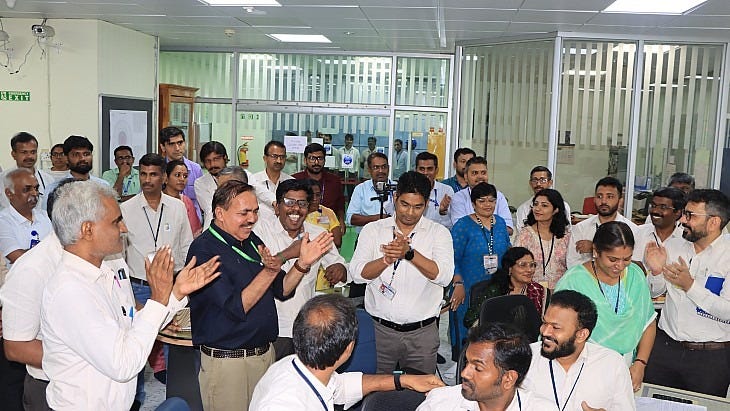
Reactor control room at Kalpakkam in Tamil Nadu April 6, 2026
1.
India’s fast breeder reactor attains criticality: Here’s why it matters (T)
On April 6, 2026, the Prototype Fast Breeder Reactor (PFBR) achieved a sustained controlled chain reaction, generating energy continuously. This achievement of criticality is a major step in India’s nuclear energy program. This 500 Megawatt electric sodium cooled, pool type liquid metal uses fast neutrons to sustain fission and to facilitate breeding. The neutrons are absorbed by Uranium 238 nuclei in a blanket surrounding the reactors which are converted into fissile Plutonium 239 enabling the reactor to produce more fuel than it consumes.
The reactor is designed to eventually utilize Thorium 232 in the blanket which can be converted into fissile Uranium 233. This would be a major breakthrough for India which has a large reserve of Thorium.
The only other operational Fast Breeder Reactors are in Russia and China. Russia has two that are cooled with liquid lead and China has one cooled with liquid sodium and a second that is under construction.
2.
A New Oil Shock Accelerates a Return to Nuclear Power (P)
Disruptions in availability of oil are prompting a number of countries that have been opposed to nuclear energy to rethink their positions. This is happening in Taiwan, Japan, South Korea, Italy, Switzerland, and Germany. Taiwan procures about a third of its LNG from Qatar, prompting officials to scramble for additional shipments from the United States. Japan is revising its antiterrorism requirements to effectively prevent the shutdown of some operational reactors and to facilitate restarts. South Korea is accelerating maintenance on five nuclear plants in order to implement earlier than originally planned restarts. In Italy, a law has been proposed to develop new nuclear technologies. In Switzerland discussions are taking place regarding an existing ban on nuclear construction with the aim of implementing a nationwide vote. The outlook in Germany is more mixed, but shows signs of support for restarting nuclear energy generation.
3.
TerraPower and SoftServe Integrate NVIDIA Omniverse to Speed Advanced Nuclear Energy Deployment ( C )
TerraPower and SoftServe are using the NVIDIA Omniverse AI platform to accelerate the siting and design of Bill Gates’ TerraPower’s Natrium reactor. Site-specific design work can be reduced from 18 months to as short as eight weeks. The new platform addresses the industry’s most significant bottleneck, which is the early stage site engineering and design phase.
4.
NRC Launches Fresh Licensing Framework for New Reactors (P)
N.B. The following was prepared by the AI agent Claude in response to a request for a 300 word summary of the new licensing initiative by the Nuclear Regulatory Commission:
The NRC’s New Part 53 Licensing Framework
On March 25, 2026, the NRC approved a final rule establishing a new risk-informed, performance-based, and technology-inclusive regulatory framework for licensing commercial nuclear plants — the first new reactor licensing regulations since 1989, when the NRC created Part 52, and the first major update since 1956, when the Atomic Energy Commission issued Part 50. Perkins Coie
Known as 10 CFR Part 53, the rule establishes a new optional pathway for licensing new — and existing — reactor technologies. It is less prescriptive than the existing frameworks in Parts 50 and 52, which remain available. Rather than eliminating those pathways, Part 53 provides applicants with a far more flexible regulatory framework adaptable to nuclear technologies beyond traditional light water reactors, meaning developers will no longer need to seek specific regulatory exemptions from requirements designed for different technologies. Morgan Lewis
Part 53 covers several important dimensions: broad applicability to any reactor type (including advanced non-light-water designs); increased flexibility through a performance-based approach that gives reactor designers more latitude in how they construct and operate plants; and modern risk assessment tools, allowing developers to use probabilistic risk assessments tailored to the specific design of their reactors, departing from the traditional “single-failure criterion.” American Action Forum
Part 53 also introduces graded security requirements, staging of licensing in phases, and clearer, more predictable approval pathways — all expected to significantly reduce the time and cost required to bring new reactors to market. NRC
The legislative foundations trace to the Nuclear Energy Innovation and Modernization Act (2019) and the bipartisan ADVANCE Act (2024), reinforced by four Trump administration Executive Orders in May 2025 aimed at expediting nuclear permitting and reforming the NRC. Perkins Coie
Complementing Part 53, the NRC also issued a proposed rule in April 2026 that would streamline commercial licensing for reactor designs previously authorized and tested under DOE or DOD programs, allowing applicants to reference those prior authorizations and avoid duplicative review. Perkins Coie
Part 53 becomes effective on April 29, 2026. Morgan Lewis
5.
The Trump Administration Is Doing Something Horrifying to Workers at Nuclear Facilities (P)
The U.S. Department of Energy has taken a step to cancel an important guideline for nuclear radiation safety. It has instructed the Nuclear Regulatory Commission to reconsider reliance on the linear no-threshold (LNT) model for radiation exposure. The LNT is based on the scientifically accepted view that there is no level of radiation exposure that is safe. The NRC has been adhering to the LNT to enforce a guideline for radiation exposure that is “as low as reasonably achievable.” The vast majority of the scientific community adheres to the LNT. Not to do so, will be seen by many as opening opportunities for exposure to dangerous levels of radiation.
6.
Framatome signs VVER-440 fuel agreement with EU utilities ( C )
Framatome, a French nuclear company, owned by Electricite de France, has signed an agreement with four European utilities to supply fuel for VVER power plants that were built in Russia. These companies are in the Czech Republic, Hungary, Slovenia, and Finland. Given the current conflict with Russia, countries with VVER reactors are seeking secure sources of fuel.
7.
World’s First Microreactor Test Bed Now Open for Business
( C )
The Demonstration of Microreactor Experiments (DOME) has been established at Idaho National Laboratory (INL). DOME will enable rapid development, testing and demonstration of privately developed advanced nuclear reactors. It is an actual dome, 100 feet tall and 80 feet in diameter that provides a safe environment to test experimental reactor concepts. It is the only test bed in the world designed to host fueled microreactor experiments that generate up to 20 megawatts of thermal power. This construction is designed to be factory built and used in lieu of diesel generators. They could also be used in space or maritime applications. They could also meet expanding needs of data centers. Dome’s first use will be a year-long test program with Radiant of their Kaleidos Demonstration Unit that uses TRISO fuel and helium gas to transfer heat from the core.
8.
New Jersey moves on from de facto nuclear moratorium (P)
New Jersey has lifted a moratorium on nuclear reactor construction. This follows similar action by Illinois and anticipated nuclear endorsements in California and Minnesota. This was a legislative act that was signed by Governor Mikie Sherrill and endorsed by other political figures including Senator Booker.
9.
In pushing Trump nuclear plan, DOGE cracked jokes about risks to Utah residents ( An article about the Trump administration’s attack on the Nuclear Regulatory Commission ) (P)
This article reviews the shift away from safety outlook that has dominated the actions of the Nuclear Regulatory Commission (NRC) to a less cautious approach that is being driven by Seth Cohen, a 31 year old recent law school graduate who has been appointed chief counsel for nuclear policy at the Department of Energy. Cohen said, “Assume the NRC is going to do whatever we tell the NRC to do.” Longtime observers worry that the NRC is no longer an independent regulator. Allison Macfarlane, who is a past NRC chair commented that personal interests are being served by current Department of Energy administrators. Particularly worrisome is the loss of over 400 people who have left the agency since Trump took office. Strong deregulation voices include Peter Thiel and Marc Andressen who are Trump supporters with investments in the nuclear sector. Vast numbers of regulations are being rewritten and timetables for new reactor development are being accelerated. Cohen recently engaged in activities that promoted the work of Valar Atomics, a company that the NRC is mandated to regulate. New regulations that are being promoted include reductions in safety and security inspections along with significant changes in radiation guidelines that allow higher exposure levels to workers and the public. Cohen is making it easier to reduce the amount of protective shielding used in reactor construction. He is also promoting a five fold increase to the limit for public exposure to radiation. Cohen, in an address to the American Nuclear Society said that rapid buildout of nuclear energy was essential for the development of America’s AI industry.
10.
Kairos breaks ground for Hermes 2 reactor ( C )
Kairos Power has received a construction permit to build a fluoride salt reactor at Oak Ridge. It will incorporate the use of TRISO fuel and utilize modular construction that will allow factory production. This reactor design is intended for use with Google data centers.
11.
Less Support in U.S. for Solar, Wind Energy; More for Nuclear (P)
The latest findings from a Gallup poll show that while most Americans prefer the U.S. to put more emphasis on solar and wind energy, there has been an increase of support for nuclear energy. 66% of Americans favor more emphasis on solar energy and 55% favor more emphasis on wind energy. Since 2021 support for nuclear energy has increased from 39% to 45%. The level of support for natural gas is at 43%, while that for oil stands at 34% with support for coal at 25%. There are strong disparities between the attitudes of Republicans in most areas. Democrats favor Solar at 87% compared with Republicans at 38%, while the comparison with regard to Wind see Democrats at 81% compared with Republicans at 22%. The nuclear responses show 52% of Republicans in favor compared with 42% of Democrats. Republicans favor Natural Gas at 59% compared with 28% for Democrats. The results for Oil find that 54% of Republicans are in favor while the favorable level for Democrats is 17%. In the coal ratings, Republicans are at 39% with Democrats at 9%.
In polling regarding support for nuclear energy construction, 53% opposed a nuclear plant in their area.
12.
Nuclear reactor maker X-Energy valued at $11.9 billion in stellar Nasdaq debut (T)
In an initial public offering X-Energy, a company that seeks to build a small modular reactor cooled by Helium gas and which also manufactures the advanced nuclear fuel, TRISO, achieved a valuation of $11.9 billion. Customers for the X-Energy’s Xe-100 reactor include Amazon, Dow Chemical, and Centrica, a British-based multinational energy company. Amazon, which has an equity interest in X-Energy, seeks the use of the Xe-100 to provide power for AI processing. The Xe-100 reactor is expected to become operational around 2030.
13.
NRC Proposes a New Licensing Framework to Accelerate Safe, High-Volume Deployment of Microreactors (P)
On April 27, 2026 the Nuclear Regulatory Commission announced a proposed rule that would allow rapid deployment of microreactors. The new rule would allow requesting approval for fleets of identical reactors and allowing use of alternative designs and programs for novel reactor operations as well as pathways for limited construction prior to receiving an NRC permit. The NRC considers a microreactor as one that produces about 10 Megawatts of electrical power. This compares with a small reactor that produces about 300 Megawatts of electrical power and a full sized reactor that produces about 1000 Megawatts of electrical power. Microreactors could potentially be mounted on a truck and could be useful in powering AI data centers.
14.
Yes, Nuclear. How Much? How Soon? (P)
This posting is the transcript from the Substack of Robert Bryce, author and commentator on energy issues, in which he conducts a wide ranging discussion with Jim Burke and Ray Rothrock. Jim Burke is the CEO of Vistra, a leading Fortune 500 integrated retail electricity and power generation company. Ray Rothrock is a nuclear investor and board member at Centrus Energy, the world’s most diversified supplier of uranium fuel for nuclear power and national security. This discussion is exceptional in that it is a comprehensive analysis of the current aspects and future prospects for the nuclear energy industry. It is highly recommended.