

Nuclear Tomorrow - June 2026
Nuclear Tomorrow is a newsletter that is issued monthly to identify press reports on developments in the field of nuclear energy. Topics are selected for their relevance to the impact of nuclear energy on global warming. The newsletter is written for members of the general public who are concerned with policy related to these issues. Postings are categorized as dealing with Technology (T), Policy (P), and/or Construction (C). In some cases registration or a fee is required to access an article. Hyperlinks are provided to connect newsletter posts to the referenced publication. (See hot buttons associated with each posting) The newsletter is intended to expand on topics included in the book, “Nuclear Energy: Boom, Bust, and Emerging Renaissance,” which has recently been published by Oxford University Press. The author of the book and of this newsletter is Edward A. Friedman, Emeritus Professor of Technology Management at Stevens Institute of Technology in Hoboken, New Jersey, USA. The book is available for purchase via the Oxford University Press Website. The following link provides access to the book:
https://global.oup.com/academic/product/nuclear-energy-9780198925781?lang=en&cc=gb#
NOTE - A 30% Discount is available using the code AUFLY30
for purchases through Oxford University Press
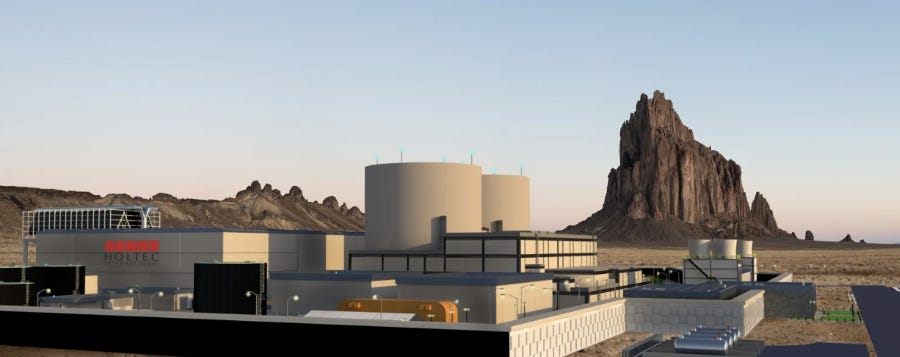
Concept Art of the Holtec SMR 300 facility
Blue Castle project to be revived as SMR (T)
Plans are moving forward to construct two to four Holtec Small Modular Reactors at the Blue Castle site in Utah. Discussions have been underway since 2007 for development of nuclear power at this site. The Holtec design that uses air cooling is ideal for use in this arid location where water is scarce. The project is in a preliminary phase with details to follow in the context of community discussions. There exists local support to have a hub for nuclear power at this location in southeast Utah. This 300 Megawatt electric reactor utilizes passive gravity driven safety systems that do not rely on pumps, external water, external power, or operator action. Work is underway to construct two of these units in Michigan.
2.
Antares’ reactor meets DOE milestone (T)
As part of a Department of Energy Reactor Pilot Program, start-up Antares Nuclear’s Mark-0 completed a criticality demonstration at the DOE Idaho National Laboratory. The reactor achieved criticality but did not have a power conversion loop or a heat-sink installed so there was no power output. The reactor runs on just under 20% enriched uranium and TRISO fuel. TRISO fuel consists of Uranium Oxide embedded in graphite and coated with ceramic material. It can withstand thermal and mechanical stress at temperatures of 1600 deg Centigrade. The Mark-0 is the first non light water cooled reactor to go critical in the US in more than 40 years. The next step in this reactor development program is to implement the Mark-1 which is designed to produce between 100 kWe and 1 MWe with a compact size that could be transported in several standardized shipping containers. The novel design features heat-pipe cooling that does not require pumps or moving parts. The heat generated vaporizes liquid sodium which travels to a heat exchanger and after cooling into a liquid returns to the core via capillary action in which molecules in the liquid are attracted to molecules in the heat pipe.
The reactor is controlled with drums that surround it and reflect or absorb neutrons depending on the configuration of the drum material. This eliminates the use of control rods that penetrate the reactor. The drums are controlled by independent electromechanical drives that provide redundant safety.
3.
Japan could replace up to 14 reactors by the 2050s under new proposal (P)
Japan will need to replace as many as 14 of its nuclear reactors by the 2050s in order to meet its energy demands, a recently released draft policy proposal states. The plan has the nuclear share of the country’s power generation growing from 8.5% to approximately 20% by 2040.
4.
Why China is betting on big nuclear reactors (P)
While the United States is focussing on small nuclear reactors while China is moving forward with large units. China started six new large reactors in 2025 with two additional units during the first five months of 2026. The average time for new reactor construction in China is between five and seven years. The global average is nine years and the two most recent reactors in the US took about 15 years. The key to this performance in China is standardization with uniform design and licensing and of batches of six or more that take advantage of economies of scale. This approach is bolstered by heavy investment from the government.
5.
Governor Hochul Announces Major Milestone to Facilitate New Advanced Nuclear Development (P)
Governor Hochul announced on June 11th the start of a full examination of ways to bring new advanced nuclear power online in a timely, cost-effective manner. “Advanced nuclear is one of the best available options to provide both relief to consumers and strengthen the resilience of New York’s grid with round-the-clock emission free energy,” Governor Hochul said. New York State has also embarked upon a $40 million commitment for nuclear workforce training. The Department of Public Service is scheduled to prepare a white paper on issues and options regarding nuclear development by November 11, 2026.
6.
Japan begins 20th release of Fukushima nuclear-tainted wastewater into sea ( C )
On June 1st, Japan began a new round of discharge of nuclear-contaminated wastewater from the crippled Fukushima Daiichi Nuclear power plant into the ocean marking the 20th such release since this controversial operation began in 2023. This activity has been opposed by local fishermen, residents as well as
Many in the international community. Nearly 150,000 tonnes of wastewater have been released to date.
Note added by EAF:
The IAEA has been monitoring these releases and finds that the discharges meet international safety standards. It is also significant that there has been no price drop at regional fisheries.
Furthermore China’s fish ban for imports was lifted in 2024.
7.
Renewed Bruce 3 back in service ( C )
Bruce Power in Canada provides 30 percent of Ontario’s power.
The power station consists of eight CANDU pressurized heavy water reactors each providing in excess of 800 Megawatts of electricity. In order to extend the lifetime of these reactors by 20 years a refurbishment program has been implemented to allow operations until the 2060’s. Units 1 and 2 have been refurbished and Unit 3 completed refurbishment on June 3, 2026. This action had been originally scheduled for completion in January 2027. This 7 month ahead of schedule success is seen as an important milestone.
8.
Chubu Electric rigged quake data to dodge plant upgrades (P)
In April 2026 a report revealed that Chubu Electric Power Company had falsified data at Hamaoke nuclear plant in at least
80 separate cases and had ignored internal warnings for many years. An investigation revealed that fraud began in 2018. Reports on seismic activity were falsified to avoid additional construction requirements. This situation was revealed by whistleblower reports.
9.
Editorial: Japan’s plan to replace aging nuke reactors far from gaining public understanding (P)
The Ministry of Economy, Trade and Industry announced a goal to replace up to five reactors by the 2040s and to rebuild nine more by the 2050s. If implemented this will increase the nuclear share in the country’s energy mix from 9.4% in 2024 to around 20% in 2040. There are deep-seated anxieties among residents about a double disaster of an earthquake and a tsunami triggering a nuclear accident. Concerns also exist over shortages of engineers
and other personnel supporting safety. In addition the industry culture revealed by the Chubu scandal adds to these concerns.
10.
Rolls-Royce, United Kingdom National Laboratory and Japan Atomic Energy Agency to co-operate on advanced nuclear technologies (P)
Two trilateral cooperative agreements have been executed joining Rolls-Royce, the United Kingdom National Nuclear Laboratory and the Japan Atomic Energy Agency to accelerate development of advanced nuclear technologies. Of immediate interest is the development of gas cooled high temperature modular reactors and the ceramic coated fuel that is used to power them. This parallels the development of helium gas cooled high temperature reactors that is being implemented in China and which is being initiated in the United States.
11.
Russia and Laos Sign Nuclear Energy Cooperation Agreement (P)
Russia and Laos have signed an agreement to explore construction of a nuclear reactor in Laos. This is part of an aggressive Russian outreach in Southeast Asia for nuclear energy relationships. It follows negotiations that have been
Pursued by Russia in Vietnam and in Myanmar.
12.
Regulatory Delays Stall Nuclear Reactor Construction (P)
The House Subcommittee on Energy is reviewing regulations and reviews of new nuclear reactors to shorten the time for licensing. This initiative attracts bi-partisan support with Republicans who seek expanded energy sources and Democrats who seek reduced carbon emissions. The hearings have not yet confronted the safety challenges brought about by reductions in review time.
13.
Energy Dept Unveils $17.5 Billion Plan to Kick-Start New Nuclear Plants (P)
The Energy Department will provide up to $17.5 Billion in low-cost loans to help electric utilities buy expensive components for use in up to 10 AP100 nuclear reactors fabricated by Westinghouse. The utilities would have to invest hundreds of millions of dollars of their own money to unlock the federal financing. To date no plans have been announced to actualize this scheme. This federal program seeks to stimulate five pairs of reactors around the country. For each pair the utility would provide $500 million and Westinghouse would provide $500 million with the federal government providing approximately $4 billion in debt. Given all the uncertainties there is no guarantee that any company will go ahead with this program. The largest uncertainty is the poor track record of Westinghouse in its construction of AP100 reactors.
14.
Europe’s extreme heat is shutting down power plants (T)
Nuclear power plant cooling is warming rivers in France to as much as 28 deg C or 82 deg F which requires placing limits on reactor output. Several reactors have had power reductions during the June heat wave.
15.
IGCAR Kalpakkam Hydrogen Plant: India Inaugurates world’s first hydrogen plant that uses nuclear reactor heat instead of electricity ( C )
Using heat from the Fast Breeder reactor at Kalpakkam hydrogen fuel was produced. The Cu-Cl thermochemical process that was used was developed indigenously by the Bhabha Atomic Research Center. This was a breakthrough development for a valuable fuel production process.
EAF Note re advantages of hydrogen fuel - This low cost process for production of hydrogen fuel can expedite carbon free petrochemicals, steelmaking, cement production and other high temperature industrial processes. Hydrogen can also be used for long term energy storage and power transportation including cars, trucks and aircraft.
16.
Red, white and glowing blue: Trump’s push for new reactors reaches the finish line (T)
A year ago President Trump set an ambitious goal - to see at least three American companies build innovative reactors by July 4, 2026. Two companies have met this deadline and others are nearing the goal. Antares Nuclear (see item #2 in this June 2026 edition of Nuclear Tomorrow) and Valar Atomics have initiated operations in reactors but have not generated electricity from these systems. Valar is developing a high temperature helium gas cooled reactor and aims to produce fuel for heat rather than electricity.
Since these operations are taking place at national labs, safety regulations have been open to modification in order to expedite development efforts. This activity has been criticized by observers, particularly from the Union of Concerned Scientists.