

Nuclear Tomorrow - January 2026
Nuclear Tomorrow is a newsletter that is issued monthly to identify press reports on developments in the field of nuclear energy. Topics are selected for their relevance to the impact of nuclear energy on global warming. The newsletter is written for members of the general public who are concerned with policy related to these issues. Postings are categorized as dealing with Technology (T), Policy (P), and/or Construction (C). In some cases registration or a fee is required to access an article. Hyperlinks are provided to connect newsletter posts to the referenced publication. (See hot buttons associated with each posting) The newsletter is intended to expand on topics included in the book, “Nuclear Energy: Boom, Bust, and Emerging Renaissance,” which has recently been published by Oxford University Press. The author of the book and of this newsletter is Edward A. Friedman, Emeritus Professor of Technology Management at Stevens Institute of Technology in Hoboken, New Jersey, USA. The book is available for purchase via the Oxford University Press Website. The following link provides access to the book:
https://global.oup.com/academic/product/nuclear-energy-9780198925781?lang=en&cc=gb#
NOTE - A 30% Discount is available using the code AUFLY30
for purchases through Oxford University Press
First reactors brought online at world’s largest nuclear power base in China ( C )
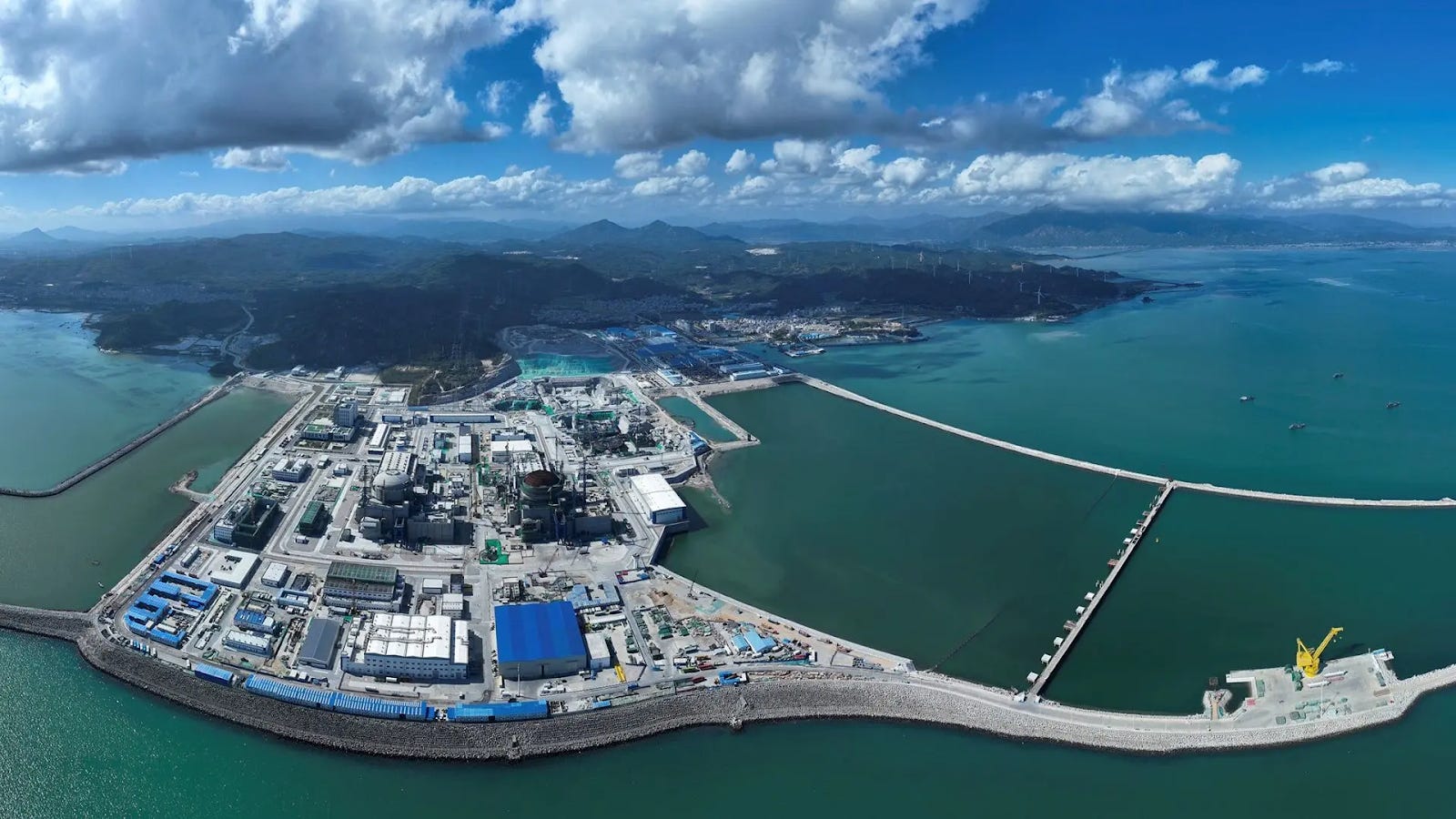
Zhangzhou in southeast China is being developed as the world’s
largest power plant, which will ultimately consist of six Hualong One reactors. This model generates 1000 Megawatts of electrical energy using a Generation III pressurized water design. On January 1, 2026 the second unit at Zhangzhou was judged to be fully operational. Zhangzhou will not only make a significant contribution to China’s decarbonization program, it will also serve as a showcase in the export marketplace for the Hualong design. It is noteworthy that this second unit became operational just one year after the first unit went online.
Idaho lab produces first fuel for fast molten salt reactor paving way for marine deployment (T)
The Idaho National Laboratory (INL) has produced chloride-based molten salt fuel for a fast reactor. The Molten Chloride Reactor Experiment (MCRE) is likely to be the world’s first molten chloride salt fast reactor. This project is a public-private partnership between Southern Company, Terrapower, CORE POWER and the U. S. Department of Energy. This design allows for higher operating temperatures, better fuel efficiency and enhanced safety. It also opens the door for compact reactors that could be used on ships and in remote locations. This technology could enable a revitalized U.S. merchant shipping fleet.
Nuclear Fuel Makers Get $2.7 Billion From US as AI Boosts Power Demand (P)
Having become dependent upon Russia for reactor fuel, the Biden administration allocated major funds to boost indigenous fuel development. This initiative has been supported and expanded by the Trump administration with the recent allocation of three grants of $900 million each, by the Department of Energy, to domestic fuel makers. The recipients are Centrus Energy Corporation, General Matter and Orano SA. While the need to replace aging reactors becomes more urgent, the market for domestic fuel is being driven by the expansion of energy needs coming from AI expansion.
From Waste to Watts: Advanced Nuclear Reactors and the Future of Spent Fuel (T)
American Council on Science and Health
Oklo has broken ground at Idaho National Laboratory for the Aurora sodium cooled fast reactor that will produce 75 Megawatts of electrical power. The fuel designated for this reactor will be reprocessed waste from the Experimental Breeder Reactor II that operated at Idaho National Laboratory from 1964 through 1994. The reprocessed fuel will be enriched between 5 and 19.7 %. This level of enrichment known as HALEU is not available from domestic sources in the United States. Since it is needed in a number of advanced reactor designs, its production through an electrochemical process developed at Idaho National Laboratory that is being demonstrated with the Aurora project will have an impact on future reactor developments.
5.
Government drops $800 million on 2 nuclear technology projects; ‘Shaping the nation’s …future’ (P)
The Dept of Energy awarded two grants of $400 million each to support development of small modular reactors by the Tennessee Valley Authority and Holtec Government Services. The TVA plans to build a GE reactor while Holtec is pursuing its own design.
Both reactors are designed to produce 300 MegaWatts of electrical power. The GE design uses boiling water as the coolant while the Holtec reactor is a pressurized water reactor. Four units of the GE reactor are under construction in Canada with the first planned for operations in 2029. Other units are planned for Poland, Sweden, Estonia, and Hungary.
6.
DOE kills radiation safety standard (P)
On January 9, 2026, Energy Secretary Chris Wright terminated the decades-old radiation safety standard known as “ALARA” - As Low As Reasonably Achievable. Supporters of ALARA cite the scientifically established finding that there is no safe dose of radiation, the Linear No-Threshold (LNT) model. Opponents of ALARA contend that it has been used to impose unwarranted requirements on shielding and radiation handling that in some cases have brought radiation doses well below background levels. It is argued that ALARA’s use has led to unnecessarily high costs for construction and handling of radioactive materials.
It is anticipated that elimination of ALARA will facilitate development of new reactor designs by reductions in construction costs.
7.
Meta’s Nuclear Data Center Deals May Require $14 Billion Investment (P)
To meet anticipated energy needs for AI processing Meta has entered into agreements with Terrapower and with Oklo to provide liquid sodium cooled fast reactors. These arrangements have a ten year time line. The Terrapower program envisions starting with two 345-megawatt reactors costing $4 billion each to be followed with six additional units that would each have a lower cost. The plan with Oklo is to build 16 75 Megawatt reactors at a cost of approximately $6 billion. This planning for a $14 billion program is extraordinary given that neither Terrapower or Oklo have as yet produced a reactor. It should be noted that Meta has not put all its eggs into a next generation nuclear basket but has plans for three conventional reactors through an arrangement with Vistra power generation company.
8.
NASA Commits to Plan to Build a Nuclear Reactor on the Moon by 2030 (P)
The U.S. Space Agency and the Department of Energy have announced that they plan to build a fission reactor on the lunar surface in the next four years. It will provide power for the Artemis Program, which seeks to establish a long term presence on the moon.
Supplementing this article is the following information on design of a reactor for operations on the moon:
NASA plans to build a reactor on the moon that would generate 100 kilowatts of electrical power with an anticipated weight of 15,000 kg (33,000 pounds) that would fit into a cylinder 18 feet (5.5 meters) long and 12 (3.9 meters) feet in diameter which would be within lunar landing capabilities.
A fast neutron spectrum design using highly enriched uranium would minimize size and mass.
Shielding would take into account the dust or regolith that is pervasive on the moon thus reducing the mass of shielding used in assembly. A further reduction would be a minimal requirement for shielding on sides other than that occupied by the operational team.
The design would however need to take into account the possible interference of the dust with any exposed moving components.
There are severe insulation requirements due to the extreme temperature variations found on the surface of the moon. At the moon’s equator these range from a high of 260 deg F (127 deg C)
to a low of -280 deg F (-173 deg C) which is a variation of
540 deg F (300 deg C)
The generation of electricity would be via a Stirling engine which operates via direct contact with a cold side and a hot side. A gas that is sealed within the engine forces the piston in a high temperature region to compress the gas (probably helium) into a low temperature region where a second piston moves the gas back into the high temperature region. This piston action implements work.
9.
UK maritime nuclear consortium launched (P)
An initiative has been implemented aimed at helping eliminate the 3% of global carbon emissions produced by the shipping industry. The new Maritime Nuclear Consortium - whose members include Rolls-Royce, Babcock International Group, Global Nuclear Security Partners, Stephenson Harwood and Northstandard - aims to participate in the global race to decarbonize shipping. This consortium seeks to leverage UK capabilities in nuclear energy development as well as in maritime innovation toward this
objective. Currently, Russia is the only country that employs nuclear reactors to power non-submarine shipping. It operates ice breakers in the Arctic using nuclear energy.
10.
Rosatom hopes for four foreign unit start-ups in 2026 ( C )
Russia leads the world in the export of nuclear reactors. Several dozen reactors from Russia are operational in 11 different countries. These are VVER Generation III+ pressurized water reactors that are currently installed in - India, China, Iran, Czech Republic, Finland, Slovakia, Hungary, Bulgaria, Armenia, Belarus and Ukraine. In 2026, four additional reactors are scheduled to become operational. These will be in Bangladesh, Turkey and two additional units in China. These reactors will produce 1,200 Megawatts of electrical power. They have a design lifetime of 60 years with an anticipated extendability of 20 years. The refueling cycle is 18 months.
11.
EDF Turns to China to Relearn Lost Art of Rapid Nuclear Construction After Flamanville Disaster (P)
In recent years, both the United States and France have experienced significant failures in pursuit of 1000 megawatt scale reactor construction. In the United States, Westinghouse completed the Vogtle reactor (1100 megawatts electric) construction project in Georgia in 2024 7 years behind schedule and 140% over budget while Electricite de France(EDF) completed the Flamanville 3 (1650 megawatts electric) reactor construction project 13 years behind schedule and 300% over budget. In contrast, China has built 37 reactors between 2015 and 2024 with an average time from first concrete to grid connection of 6.3 years, beating the global average of 9.4 years, with the fastest build time at 4.1 years. As France and the United States seek to reestablish past performance levels of competence in large reactor construction, the French have turned to China for assistance. A program has recently been initiated that will embed French personnel for month-long immersions at China’s nuclear development organizations. They will study specific aspects of construction processing including work flow optimization, just in time parts delivery, streamlined quality control and minimizing onsite storage. This program represents a role reversal from 1989 when France hosted110 Chinese engineers for exposure to French methods of reactor construction. This was in support of the development of China’s first nuclear reactor at Daya Bay that provided energy to the Guangdong region of China and Hong Kong. We see that after 37 years, China’s nuclear sector has moved from being a mentee to that of being a mentor.
12.
Plans for two new reactors confirmed by South Korea ( C )
South Korea has confirmed that it plans to build additional nuclear reactors with a capacity of 2,800 Megawatt electric as well as a 700 Megawatts electric or small modular reactor capacity by 2038. This adds nuclear power capacity to the ongoing construction of two APR1400 reactors that are scheduled for completion in 2032 and 2033. These reactors will contribute to the plan for South Korea to become carbon neutral by 2050.
Simultaneously, South Korea is pursuing an aggressive export program, having signed a deal with the Czech Republic in June 2025 to build two 1055 Megawatt Electric APR1400 reactors with construction to begin in 2029 and the first reactor coming online in 2036. This marks a gap of several years since South Korea successfully installed four reactors in the UAE in 2021, 2022, 2023, and 2024.
13.
China Starts construction of innovative nuclear project ( C )
The Xuwei Nuclear Heating and Power Plant in Jiangsu Province initiates a highly innovative use of nuclear energy. In January, 2026 first concrete was poured marking the beginning of a project to construct three nuclear plants that will produce both electricity as well as high temperature steam. Included are two 1208 Megawatt electric Hualong One third generation pressurized water reactors and one 660 Megawatt electric high temperature fourth generation gas cooled reactor. Combined, these reactors will produce both electricity and high temperature steam for the adjacent industrial complex. High temperature steam, above 400 degrees Centigrade is needed for manufacture of steel, cement, glass, ceramics, and petrochemicals which cannot be addressed with renewables of wind and solar heating. Given that about 25 percent of greenhouse gases originate from these and other high temperature processes, this project represents a significant advance in the use of nuclear energy to ameliorate global warming.