

Nuclear Tomorrow - December 2025
Nuclear Tomorrow is a newsletter that is issued monthly to identify press reports on developments in the field of nuclear energy. Topics are selected for their relevance to the impact of nuclear energy on global warming. The newsletter is written for members of the general public who are concerned with policy related to these issues. Postings are categorized as dealing with Technology (T), Policy (P), and/or Construction (C). In some cases registration or a fee is required to access an article. Hyperlinks are provided to connect newsletter posts to the referenced publication. (See hot buttons associated with each posting) The newsletter is intended to expand on topics included in the book, “Nuclear Energy: Boom, Bust, and Emerging Renaissance,” which has recently been published by Oxford University Press. The author of the book and of this newsletter is Edward A. Friedman, Emeritus Professor of Technology Management at Stevens Institute of Technology in Hoboken, New Jersey, USA. The book is available for purchase via the Oxford University Press Website. The following link provides access to the book:
https://global.oup.com/academic/product/nuclear-energy-9780198925781?lang=en&cc=gb#
NOTE - A 30% Discount is available using the code AUFLY30
for purchases through Oxford University Press
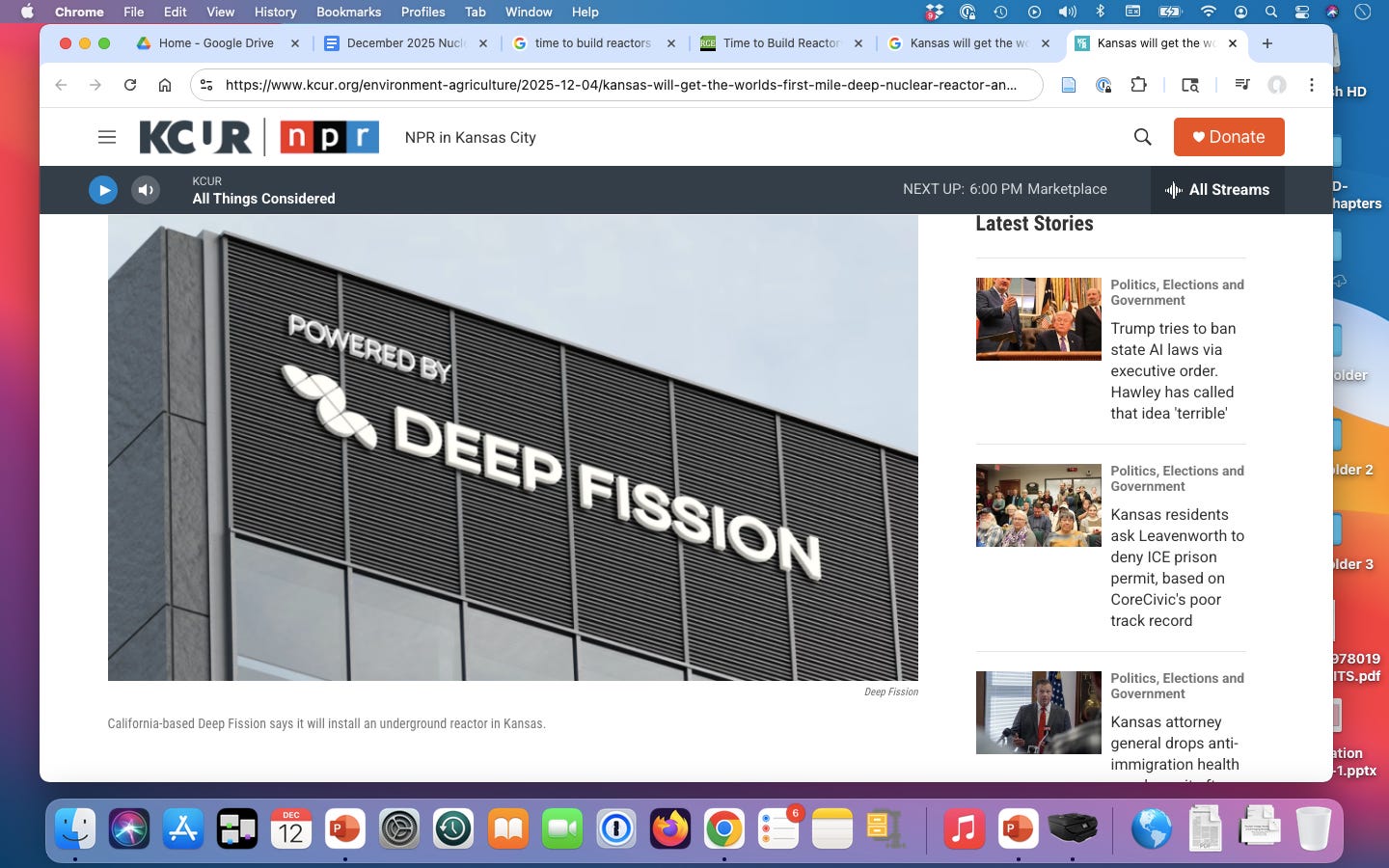
Kansas will get the world’s first mile-deep nuclear reactor and the groundbreaking is next week. ( C )
A California startup, Deep Fission, will be breaking ground in early December for a mile deep nuclear reactor in Kansas. Steam is designed to come up the bore hole to generate electricity and then return as cool water to the buried reactor. This is part of a fast track program of the Department of Energy to get at least three new nuclear designs operating at a state of steady fission before next Fourth of July. The borehole drilling is standard practice from the oil and gas industry. A well tested pressurized water reactor design is planned for this system. Upon the end of the lifecycle of this reactor the facility could be buried in place.
Energy department hands out $800M in grants for small nuclear reactors (P)
The Tennessee Valley Authority and Holtec will each receive $400 million from the Department of Energy to build small nuclear reactors. The TVA will build a 300 megawatt reactor from GE Verona Hitachi in Tennessee while Holtec will build two 300 megawatt reactors in Michigan. These reactors are Generation III+ designs which are refinements of existing designs that have been built and have been in use for decades. By shrinking them down to small modular size the hope is that they will be amenable to mass production.
3.
Putin says Russia is ready to supply ‘uninterrupted’ fuel to India despite objection from Trump (P)
In addition to supplying oil to India, Putin announced plans to assist India in construction of its largest nuclear power plant.
4.
Idaho lab produces first-ever fuel for fast molten salt reactor experiment, opening door to maritime commercial reactor deployment (T)
Fuel for a molten salt reactor requires liquid fuel which contain fissile material in a mixture of salts. A team at Idaho National Laboratory succeeded in converting uranium metal into uranium chloride that could become part of the fuel salt mixture. This formulation yields a fuel that is efficient, safe and has long term sustainability. This fuel can power fast reactors that have promise for applicability in the maritime market. Operations are targeted for 2030. Participating in this initiative are Southern Company, Terrapower, CORE POWER, and the U.S. Department of Energy.
5.
Bill Gates Terrapower gets NRC green light for safety in constructing its first nuclear power plant ( C )
Terrapower has passed the Nuclear Regulatory Commission staff’s final safety evaluation to build a reactor in Wyoming. Terrapower, which is a Bill Gates enterprise, Natrium design pairs a small modular reactor with an integrated thermal battery to generate 345 megawatts of continuous electrical power. This project will replace a coal powered plant with a completion date of 2030. The NRC said that there would be no safety aspects that would preclude issuing a construction permit for this reactor. This review took place on an accelerated schedule.
6.
Trump Regulators Ripped for ‘Rushed’ Approval of Gates Reactor in Wyoming (P)
The review process for the Terrapower reactor at the NRC was originally scheduled for completion in August 2026 was expedited amid political pressure from the Trump administration and completed in December 2025 ( see item 5 above ). Edwin Lyman of the Union of Concerned Scientists issued a highly critical assessment of this NRC action. Lyman called the expedited safety evaluation, “... a complete abandonment of its obligation to protect public health, safety, and the environment from catastrophic nuclear power plant accidents or terrorist attacks.”
Lyman pointed out that the Natrium reactor uses liquid sodium coolant that can catch fire and that it has inherent instabilities that could lead to a rapid and uncontrolled increase in power.
He goes on to state: “Of particular concern, NRC staff have assented to a design that lacks a physical containment structure to reduce the release of radioactive materials into the environment if core melt occurs. Terrapower argues that the reactor has a so-called “functional’ containment that eliminates the need for a real containment structure. But the NRC staff plainly states that it “did not come to a final determination of the adequacy and acceptability of functional containment performance due to the preliminary nature of the design and analysis.
Even if the NRC determines later that the functional containment is inadequate, it would be utterly impractical to retrofit the design and build a physical containment after construction has begun.”
8.
How America Gave China An Edge In Nuclear Power (P)
This article presents the history of molten salt reactors starting with the work of Alvin Weinberg in the early 1950’s at Oak Ridge. Weinberg oversaw the development of a molten salt reactor that went critical in 1954. This was followed by a second design but in 1973 this initiative was terminated by President Nixon who was convinced by his advisors to prioritize alternative nuclear reactor designs. In 2015, at the height of U.S. - China collaborative efforts, there was Chinese-American joint interest in developing molten salt reactors. Their initial efforts involved reviewing the earlier work by Weinberg. This collaboration ended in 2016 when Trump put a stop to joint work with China. While the Americans did not have the resources to continue independent development work, the Chinese were well funded and continued their pursuit of a molten salt reactor. This effort led to a working molten salt reactor in China in 2023 which has successfully been refueled without being shut down. Currently, Kairos Power, a start up company, has received funding from the Department of Energy that supplements their privately acquired resources to build a molten salt reactor at Oak Ridge, Tennessee. They started construction work in 2025. The molten salt reactor design promises safer operations since it does not need to be pressurized and will automatically shut down if there is overheating. Lower costs are associated with its construction and it has the potential of burning nuclear waste as fuel. These and other advantages make it a highly desirable design.
9.
UK achieves early milestone in plutonium disposal programme (T)
The UK has accumulated 140 tons of plutonium from reprocessing civilian nuclear power reactor fuel over many decades. A large-scale program has been initiated to dispose of this plutonium by processing it into ceramic located pellets or blocks that can then be buried. An initial batch has now been successfully processed. Research and testing are continuing but a successful outcome is anticipated. It is anticipated that disposal of the accumulated plutonium will take many decades
10.
Browns Ferry licensed for operation to mid 2050’s ( C )
The Browns Ferry Nuclear power generating plant located in Alabama was opened in 1966. It consists of three reactors which generate a total of 3,954 Megawatts of electricity. It is the third largest nuclear installation in the United States. With its initial licensing for 40 years coming to term, the NRC renewed the license for 20 years to 2006. With that renewal coming to term a second 20 year renewal was issued in 2025 to carry its operation forward to the mid 2050’s. Thus a full 80 year lifetime is anticipated. During the next 10-15 years an addition of 244 Megawatts electrical power is planned.
11.
China launches HTGR industrial alliance (P)
The China National Nuclear Corporation has brought together more than 60 organizations to collaborate and coordinate in the development of High Temperature Gas Cooled Reactor Technology. The consortium will develop end ot end programs for HTGR technology including: research, design, fuel manufacturing, equipment manufacturing, maintenance, and overseas exporting.
12.
Restart of Kashwazaki-Kariwa reactors approved by regional assembly ( C )
Although unaffected by the 2011 earthquake and tsunami that damaged the Fukushima-Daiichi plant, the seven unit Kashwazaki-Kariwa seven unit power plnt was shut down and units 6 and 7 have received approval for restart. During the shut down period improvements in their earthquake resistance were implemented. These 1356 Megawatt electric plants are of a boiling water design that went online in 1996 and 1997. Prior to 2011, Japan’s 54 reactors provided 30% of its electricity. Of the 34 operable reactors, 14 have been restarted and 11 are pursuing restart approval.
13.
Cheap Solar Is Transforming Lives and Economies Across Africa (T)
This report on the dramatic expansion of solar energy exported to Africa from China during 2025 deserves special attention in this Substack devoted to nuclear energy. During the first 10 months of 2025 solar imports from China rose 50 percent! From almost nothing in 2019 solar has risen to almost 10 percent of South Africa’s electricity in 2025. While South Africa is the largest destination for Chinese solar technology it is not alone. Sierra Leone now obtains more than half of its electricity from Chinese Solar and Chad is just under fifty percent. China is also bidding on a $25 billion grid expansion in South Africa and seeks to have operating contracts. China seeks to replicate build-operating contract initiatives that it has implemented in Brazil and the Philippines. While the low cost of Chinese solar panels and batteries is providing reliable low cost electricity for segments of the South African economy such as the hotel and winery industries it is still beyond the reach of the lowest income segments of society. Most promising is the steady replacement of coal power in South Africa with solar.
14.
Lead-cooled nuclear reactors edge closer to reality as French firm files design (T)
The French firm Newcleo has submitted a design for a lead cooled modular reactor to Euratom for review which is expected to take two years. Lead coolant for a reactor is readily available, inexpensive and not chemically reactive. Such reactors also have the advantage that they can operate at atmospheric pressure. The design is for a 200 Megawatt electric reactor aiming toward having a commercial power plant by 2032 with production of reactors that can be fabricated at a factory and shipped to an installation site elsewhere.
Nuclear Tomorrow is a valuable newsletter that provides realistic coverage of news about nuclear power worldwide.
John Shanahan, host of website allaboutenergy.net
Thank to Edward Friedman